 Isidora & Cos Explain
A Monastery Older Than Islam Just Agreed a Deal With Egypt. Why Did It Need One After 1,500 Years?
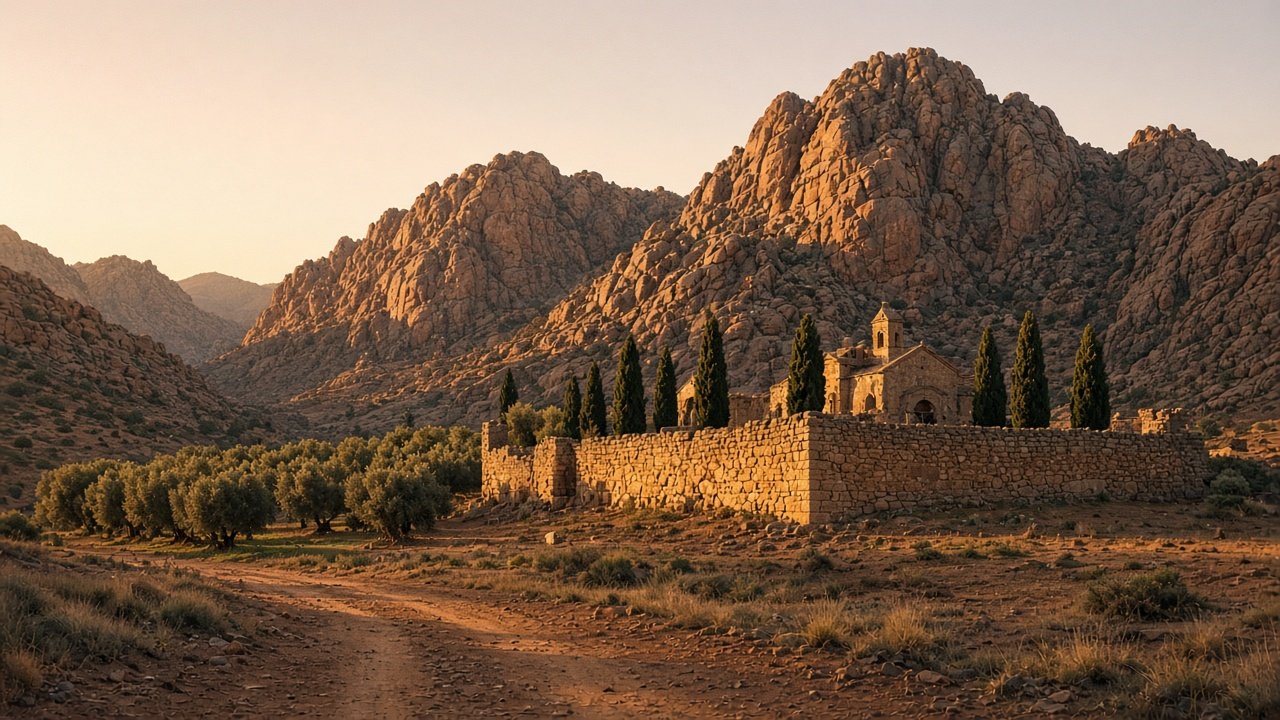
On 24 October 2026 the Archbishop of Sinai said he will sign an agreement with Egypt on the legal status of Saint Catherine's Monastery, hours before Egypt's top court was due to rule on its lands. Why a sixth-century Greek Orthodox monastery in the Egyptian desert never had a clear legal footing, what Cairo and Athens each wanted, what the deal reportedly contains, why some monks call it a surrender, and who is missing from the conversation. History explainer with a short opinion section.
On Saturday 24 October, hours before Egypt’s Court of Cassation was due to rule on the lands of Saint Catherine’s Monastery, Archbishop Symeon of Sinai announced that he would sign an agreement with the Egyptian state. Greece’s foreign minister called it “a historic day” that ends 1,500 years in which the monastery’s legal status was “uncertain and unregulated”. Egypt’s foreign ministry welcomed it too, noting that Egypt had cared for the monastery “for more than 1,600 years”.
Both sides are pleased, and both frame the same history differently. To see why a desert monastery needed a contract at all, you have to start in the sixth century.
A fortress for monks, older than Islam
The monastery was built by the Byzantine emperor Justinian around the site Christians identify as the Burning Bush of Moses. Roof beams in its church honour Justinian and his “late” empress Theodora, which lets historians date its completion to between her death in 548 and his in 565, as a University of Michigan expedition established. That is a few decades before the rise of Islam. UNESCO calls it the oldest Christian monastery still used for its original purpose, and the whole area, Mount Sinai included, is sacred to Jews, Christians and Muslims.
The monastery survived because it fitted into every empire that ruled the desert. Inside its walls stands a 12th-century Fatimid mosque. Its library keeps a 16th-century copy of the Achtiname, a document that, according to tradition, the Prophet Muhammad granted the monks as a promise of protection; the Saint Catherine Foundation itself describes the original as legend. The library also once held most of the Codex Sinaiticus, a fourth-century Greek Bible. A German scholar took it to Russia in 1859 with a written promise to return it; instead it was sold to the British Museum in 1933, and 347 of its leaves are now in London.
That last story explains a lot of the anxiety around Sinai. The monks have lived for centuries on promises, privileges and goodwill rather than on title deeds.
Why modern law found a gap
Custom works until a modern state asks who owns what. Egypt’s Sinai was occupied by Israel from 1967 until April 1982, and since then Cairo has guarded the peninsula closely. Under Decree-Law 14 of 2012, land in Sinai can generally be owned only by Egyptians; foreigners can get rights of use, but not title, according to a summary by the Cairo law firm GLA. That rule is not aimed at monks; it applies to everyone.
In 2015, Egyptian authorities sued over dozens of plots the monastery used, Egypt Independent reports. In late May 2025 the Ismailia Court of Appeal ruled. Sources differ on the exact day (Egypt’s foreign ministry says 25 May, while the Egyptian daily Al-Dostor and the archbishop’s statement say 28 May), but not on the substance. The monks may use the monastery and the religious and archaeological sites, but the state owns them as public property. Contracts the monastery had signed with the local council were upheld, while the remaining plots were declared nature reserves and state land. According to an unofficial Greek translation, the court also rejected the archbishop’s appeal partly because he lacked legal standing, since the monastery was not a legal person, and it ordered eviction from some agricultural land.
Cairo said the monastery would not be closed and that worship was protected. Many in Greece heard the opposite: monks reduced to guests on their own land.
Two crises at once
The ruling split the monks. In July 2025 the brotherhood voted to remove its archbishop of 52 years, Damianos, and the Patriarchate of Jerusalem confirmed his departure that September. Symeon was elected with 19 of 20 votes. Greece meanwhile passed Law 5224/2025, creating an Athens-based public body to represent the monastery and manage its assets in Greece, which does not change anything on Egyptian soil.
The Greek newspaper To Vima describes a year of hard talks, with parts of Egypt’s justice ministry arguing that the monastery is “exclusively an internal Egyptian matter” needing no agreement, and the Cassation ruling reportedly expected to go against the monks. That expectation comes from Greek sources and could not be independently confirmed. Symeon then asked the Patriarchs of Jerusalem, Constantinople and Alexandria and the Churches of Cyprus and Greece for their view; all five backed signing within four days.
What the deal reportedly says
The text has not been published, which matters. According to To Vima, it rests on four pillars. Egypt recognises the monastery as distinct, recognises its founding charter and must protect its monastic life. Religious properties are given to the monks for use free of charge and in perpetuity, while non-religious ones are granted for use under Egyptian law. The monastery accepts Egyptian law and courts. Both sides withdraw their appeals and settle future disputes by dialogue. Greece adds that the monks get long-term residence permits.
Notice what is missing: ownership. The deal appears to work inside the court’s ruling, not against it.
The case against
Former archbishop Damianos calls the settlement “shameful and unacceptable”, Al Manassa reports. He questions whether Symeon may sign without the whole brotherhood, objects that he never saw the draft, and accuses the Greek government of pressure. Some monks reportedly ask why the signing is rushed. Their core argument is serious: a perpetual right of use is still a right granted by the state, and what one government grants, a later one could narrow.
The people nobody negotiated with
There is a third party. The Jebeleya Bedouin, traditionally said to descend from guards Justinian sent to protect the monks and now mostly Muslim, live around the monastery and work as its guides. Since 2021 Egypt’s “Great Transfiguration” project has brought hotels, villas and roads to the area. The BBC and New Lines reported homes demolished with little or no compensation and graves moved for a car park. Egypt presents the project as a gift to the world; Al-Ahram reported in June 2026 that many components were about 97.5% complete, at a cost of about 25 billion Egyptian pounds.
UNESCO’s World Heritage Committee has been worried. In 2025 it urged that further works stay halted, and in 2026 it welcomed a presidential decree from September 2025 suspending the project until its heritage requirements are met. A technical review found that parts already built could have significant permanent negative effects. An expert mission visited in July 2026, and its report is due in 2027.
My opinion
I think signing is the lesser risk. A monastery with no legal personality, facing a court that may rule against it, is in a weaker position than one with a contract Egypt’s government has publicly welcomed. Egypt’s insistence on sovereignty over Sinai is not a pretext either; it comes from a peninsula that was occupied within living memory. And the Greek government’s interest in good relations with Cairo, which its minister calls a “profound strategic relationship”, is a real constraint, not a betrayal.
But the critics are right about one thing: a deal no one outside a small circle has read cannot be judged, and calling it historic before the text is public asks for trust instead of evidence. The real test will come later. Publish the agreement, and let the world see whether the Bedouin who guarded this place for centuries get the same respect the monks are getting now.
Sources
- Hellenic Ministry of Foreign Affairs: Statement by George Gerapetritis on the Saint Catherine's agreement (24 Oct 2026)
- Egypt Today: Egypt welcomes archbishop's approval of contract on St. Catherine's Monastery (24 Oct 2026)
- Pagenews: Sinai Monastery moves toward Egypt agreement, with full statement of Archbishop Symeon (24 Oct 2026)
- To Vima: White smoke for the Sinai Monastery (25 Oct 2026)
- Al Manassa: St. Catherine archbishop agrees to sign deal with Egypt, faces internal opposition (25 Oct 2026)
- Egypt Independent: Agreement ends St. Catherine's Monastery dispute between Egypt and Greece (25 Oct 2026)
- Al-Dostor: Final ruling on disputed lands in South Sinai (28 May 2025, Arabic)
- Romfea: The Egyptian court's decision on the Sinai Monastery (unofficial Greek translation)
- UNESCO World Heritage Centre: Saint Catherine Area
- UNESCO World Heritage Committee: Decision 47 COM 7B.168 (2025)
- UNESCO World Heritage Committee: Decision 48 COM 7B.4 (2026, French)
- University of Michigan Kelsey Museum: Monastery of St. Catherine at Mount Sinai
- Egypt Ministry of Tourism and Antiquities: Saint Catherine's Monastery and its surrounding area
- Smithsonian National Museum of Asian Art: Codex Sinaiticus
- Saint Catherine Foundation: Achtinames Project
- Greek Law 5224/2025 establishing a public-law entity for the Sinai Monastery in Greece (unofficial English translation)
- Patriarchate of Jerusalem: Holy Synod decisions on the Sinai Monastery (8 Sep 2025)
- Parapolitika: Sinai Monastery elects new abbot (14 Sep 2025)
- UNEP LEAP: Decree-Law No. 14 of 2012 on the Integrated Development of the Sinai Peninsula
- GLA & Company: Ownership in Sinai Peninsula and its effect on M&A transactions
- UPI Archives: Israel returns Sinai to Egypt (25 Apr 1982)
- BBC: Mount Sinai, one of the world's most sacred places, is being turned into a mega-resort
- New Lines Magazine: Egypt's Sinai megaproject is erasing Bedouin culture
- Al-Ahram Gate: Tourism minister and South Sinai governor review the Great Transfiguration project (20 Jun 2026, Arabic)
Comments