 Isidora & Cos Explain
A Span of the Kerch Bridge Fell Into the Sea. Why Does One Bridge Matter So Much to Crimea?
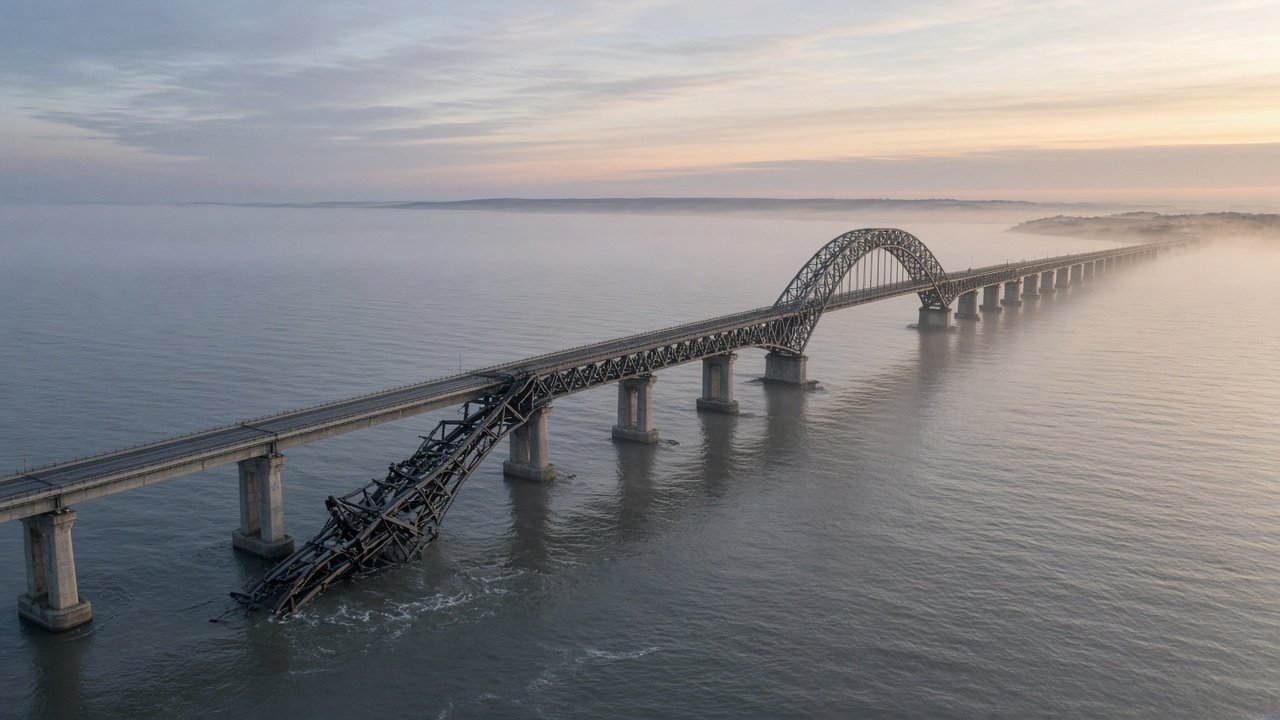
On 17 November Ukrainian missiles and drones brought down a 227-metre road arch of the bridge linking Russia to occupied Crimea. What the bridge carries, what Crimea can use instead, how long a repair could take, whether the strike was lawful, what it means for Russia's grain exports, why Washington and Berlin disagree about such attacks, and what it may change at the talks.
In the early hours of 17 November, a Ukrainian cruise missile filmed its own final seconds as it flew at the steel arches of the bridge over the Kerch Strait. By daylight, one of the two great arches, the one carrying the road, was lying in the sea. Ukraine’s General Staff said “the arch and a span of the bridge’s road section collapsed” and that no vehicle can cross; the parallel railway arch is still standing but damaged. Photos suggest the fallen arch span is about 227 metres long.
Bridges are hit in every war, including, the same night, by Russia: two bridges over the Dnipro in Kyiv. So why does this one carry so much weight?
What the bridge is
The Crimean Bridge, as Russia officially calls it, runs 19 kilometres from Russia’s Taman Peninsula across Tuzla Island to Kerch in Crimea. It is two bridges side by side: a road, opened by Vladimir Putin in May 2018 when he drove a truck across it, and a railway that opened in December 2019. It cost 228 billion roubles, about $3.7 billion at the time, and was the longest bridge in Europe.
It was built because of the 2014 annexation. Before it, Crimea’s road, rail, water and power links all ran north through mainland Ukraine. In 2014 the UN General Assembly voted 100 to 11, with 58 abstentions, to call on states not to recognise the change in Crimea’s status, and Ukraine calls the bridge illegal. For Moscow, which bases its Black Sea Fleet in Sevastopol and sees Crimea as a core security interest, it was a statement in steel that the peninsula now belonged to Russia; for Kyiv it became the symbol of the occupation.
History adds an irony. The Soviet Union built a 4.5-kilometre railway bridge across the same strait in 1944, partly from materials left by German forces. It opened in November 1944 and was wrecked by drifting ice within months, in February 1945, and was dismantled. The strait has never been easy to bridge.
What actually happened
This was not a single lucky hit. President Volodymyr Zelensky described a weeks-long operation in seven stages, in which air defence systems, radars and electronic warfare equipment around Crimea were destroyed first. A drone strike on 16 November damaged the road arch; the final blow on 17 November used domestically made drones, Neptune missiles and the heavy Flamingo cruise missile. A munitions expert at the Royal United Services Institute told the BBC that the missile may have been steered remotely, which would explain hitting the supports so precisely.
Earlier attacks were smaller. A truck bomb in October 2022 killed five people and dropped road spans, but Russia reopened the road in February 2023. A sea-drone attack in July 2023 killed a couple driving across and injured their 14-year-old daughter. This time the steel arch, the part that carries the loads over the main shipping channel, is gone.
Why it matters on the ground
Russia uses Crimea as a military base, and the bridge has been one of two main routes to supply it and the occupied south of Ukraine. The other is the land corridor through occupied Melitopol and Mariupol, which Ukraine has been hitting for months. Even before this strike, the think tank RUSI reported in July that heavy trucks were already barred from the bridge, carriers struggled to insure vehicles, and all three Kerch ferries had been put out of service by Ukrainian strikes since 2024.
What is left:
- Rail. Trains run on the bridge’s railway section, according to Russia’s transport ministry, which is adding extra trains and buses to Kerch. But Russia had already largely stopped sending fuel trains across after the 2022 fire, the Guardian notes.
- Ferries. The ministry says the Kerch ferry crossing will be used “if necessary”, but capacity is limited and depends on the weather.
- The land corridor. Long, exposed and within drone range. The pro-military Russian Telegram channel Rybar wrote that Moscow will have to “completely overhaul” its supply routes and put more protective netting over the road.
There is also the sea. Debris may have blocked the main channel under the bridge, 120 metres wide and 8.3 metres deep, the only way for large ships from ports on the Sea of Azov, including occupied Mariupol and Berdiansk, to reach the Black Sea. That matters beyond the war. The Sea of Azov usually handles about a quarter of Russia’s grain exports, according to the Moscow-based consultancy SovEcon. Shipping there has been suspended since July because of drone attacks, and SovEcon’s head warned that the wreckage means exports could no longer restart quickly even if a maritime truce were agreed.
The people of Crimea, about 2.5 million in Russia’s 2021 census (which Ukraine does not recognise), pay part of the bill. They range from people who welcomed annexation to Crimean Tatars and Ukrainians who opposed it. Russian financial site Bankiros reports that petrol on the peninsula already costs more than 100 roubles a litre and food prices rise faster than in Russia as a whole.
Can Russia rebuild it?
The Kremlin says the bridge “will be even better than before” and that a repair schedule is being drawn up. Russia did repair the 2022 damage within about four months. But engineers are cautious this time. A specialist at the engineering firm COWI told the BBC that clearing the wreckage could be quick, but “reinstating full road traffic will take over a year”. Ukrainian experts quoted by the Kyiv Independent and RBC-Ukraine give similar estimates. The new problem is that the cranes and repair crews would themselves be in range; even Rybar wrote that installing a prefabricated arch “under such conditions would be a formidable challenge”.
Was it a lawful target?
Russia’s Investigative Committee has opened a terrorism case, and Moscow describes the bridge as civilian infrastructure. Ukraine calls it the “main military crossing” into Crimea.
International humanitarian law, which both countries have accepted, judges an object by its nature, location, purpose or use: anything that makes an effective contribution to military action, and whose destruction offers a definite military advantage, can be attacked. Legal scholars at West Point’s Lieber Institute argued in 2022 that the Kerch bridge qualifies through its use to supply Russian forces, even though civilians use it too. Mixed use does not give immunity, but it does bring in the rule of proportionality: expected harm to civilians must not be excessive compared with the military gain. Russia’s transport ministry said, according to Bankiros, that preliminary data showed no one was hurt in the 16 November strike; I found no reports of casualties from the 17 November strike either.
One point is often confused. Zelensky called the strike “a response” to Russian attacks on Ukraine’s infrastructure. Under the law, an attack is lawful because of what it hits and how, not because the other side did something similar. The same test applies to Russia’s strikes on Kyiv’s bridges.
Does hitting targets like this help end the war?
Ukraine’s backers disagree. At a NATO meeting on the same day, the Pentagon’s policy chief Elbridge Colby argued that deep strikes have not slowed Russian advances and may have “hardened the Russian public’s resolve”. Germany’s defence minister Boris Pistorius called such criticism “quite a stupid thing”, and Britain’s defence secretary said deep strikes had “helped to degrade Putin’s war machine”, reports the Kyiv Independent.
Both sides have a point. A Ukrainian military source told the Guardian the timing was meant to embarrass Putin before his meeting with Xi Jinping and Donald Trump in Shenzhen on 19 November. Beijing has said nothing specific; Chinese state television reported the strike as a news item. Moscow, for its part, has every reason to treat the bridge as non-negotiable, because giving up on it would mean admitting Crimea can be cut off.
Opinion: a real blow, but not yet a turning point
The bridge was a military supply line, and by the standard the law sets it was a legitimate target. Cutting it raises the price of holding Crimea and of supplying the whole southern front. That is real leverage.
But leverage only matters if it changes decisions. Russia has absorbed heavy logistical losses before and still advanced in the east, which is Colby’s argument and should be taken seriously. Crimea can be supplied by rail, ferry and road, at higher cost and risk; an isolated peninsula is not a surrendered one. And the costs fall partly on ordinary people in Crimea, whom Ukraine considers its own citizens, and on grain buyers far from the Black Sea if the Azov channel stays blocked.
What I would watch: whether Russia tries to rebuild under fire or quietly shifts to the land corridor; whether the Azov channel reopens; and whether the bridge comes up at the Shenzhen table at all. The likeliest outcome is that the strike buys Ukraine bargaining weight and costs Russia time and money, without deciding the war on its own.
Sources
- AP: Ukrainian drones and missiles strike Kerch Bridge that links Russia with Crimea (17/11/2026)
- The Guardian: Ukraine critically damages Kerch bridge linking occupied Crimea with Russia (17/11/2026)
- BBC: How the attack on Putin's prized Crimean Bridge unfolded (17/11/2026)
- Ukrinform: Arch and road span collapse, General Staff confirms results of strike (17/11/2026)
- The War Zone: What we know about Ukraine's strikes that cut Russia's Kerch Bridge (17/11/2026)
- Kyiv Independent: Russia says it will rebuild Crimean Bridge 'even better' (17/11/2026)
- RBC-Ukraine: Crimean Bridge repairs may take over a year, expert says (17/11/2026)
- President of Russia: The President received an update on the Crimean Bridge situation (17/11/2026)
- TASS: Kremlin spokesman comments on attacks on Crimean Bridge (17/11/2026)
- TASS: What we know about aftermath of Ukrainian attacks on Crimean Bridge (17/11/2026)
- Ministry of Transport of Russia: Operational headquarters on transport links with Crimea (18/11/2026, in Russian)
- Bankiros: Two attacks on the Crimean Bridge, prices of petrol, food and holidays (11/2026, in Russian)
- RUSI: Ukraine's logistics targeting raises questions for Russia's rear defences (7/7/2026)
- President of Russia: Crimean Bridge opened to railway traffic (23/12/2019)
- DW: Russia unveils bridge to Crimea (15/5/2018)
- Wikipedia: Kerch railway bridge (1944-1945)
- Wikipedia: 2022 Crimean Bridge explosion
- Reuters: Attack on Crimean Bridge kills couple, wounds their daughter, 14 (17/7/2023)
- Lieber Institute, West Point: The Kerch Strait Bridge attack, retaliation, and international law (10/2022)
- ICRC Customary IHL Database: Rule 8, Definition of military objectives
- Kyiv Independent: Germany, UK push back after US criticizes Ukraine's deep strikes into Russia (17/11/2026)
- AP: US tells Ukraine's backers deep strikes don't work (17/11/2026)
- CBS News: Ukraine and Russia trade strikes on key bridges ahead of Putin-Trump-Xi summit (17/11/2026)
- UN press release: General Assembly calls upon states not to recognize changes in status of Crimea (27/3/2014)
- Agroexpert: Restoring grain exports in doubt because of the Crimean Bridge, SovEcon (17/11/2026)
- Wikipedia: Demographics of Crimea
- CCTV: Military morning news, Crimean Bridge attacked again, rail resumes on one track (18/11/2026, in Chinese)
Comments