 Isidora & Cos Explain
Iran Says a Supertanker Sank on an 'Unauthorised' Route. Who Gets to Decide How Ships Cross Hormuz?
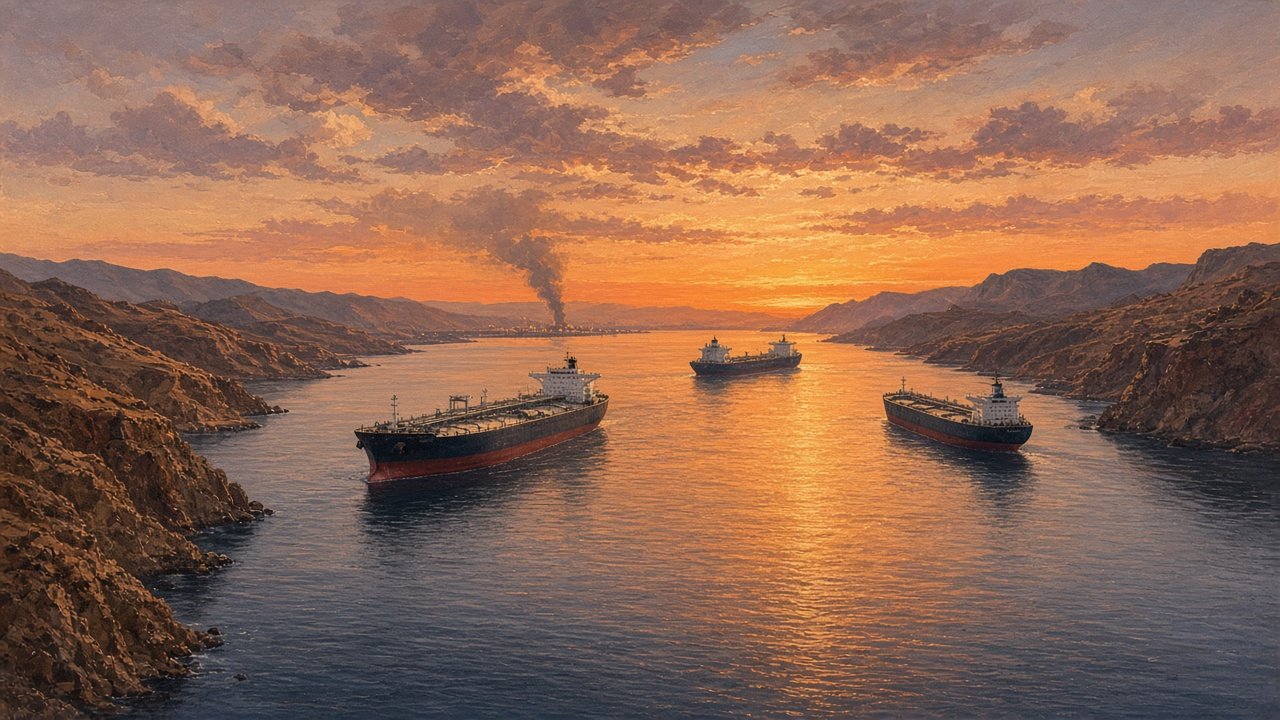
Iran's Revolutionary Guards say tankers that ignored its permit system hit mines in the Strait of Hormuz and that one supertanker sank. The sinking is unconfirmed, but the dispute behind it is real: Iran says ships need its permission, while the US-protected route through Omani waters asks for no one's. What the law of the sea and the law of naval war say, why Iran disagrees, what Oman, China and India want, why no court can settle it, and what a 19th-century Danish toll tells us.
On Sunday, Iran’s Islamic Revolutionary Guard Corps (IRGC) said two oil tankers had hit naval mines in the southern part of the Strait of Hormuz, and that one of them, a supertanker carrying more than two million barrels of crude, had sunk. The Guards did not name either ship. The word they chose mattered more than the details: the tankers, they said, had used an “unauthorised” route.
That word is the real story: a claim that one coastal state can decide which way the world’s ships cross one of its busiest waterways.
What we actually know
The IRGC did not identify the vessels or crews, and according to Seatrade Maritime its video shows a large fire on the water but no discernible ship.
What is confirmed is that ships are being hit. Britain’s UKMTO monitoring centre relayed an Indian report that a tanker was attacked on Sunday, crew safe; the security firm Vanguard Tech, quoted by Seatrade, named it as the supertanker Al Dhannah, damaged at the stern and heading back to Dubai. Nobody has shown it was one of the ships in Iran’s statement. On Monday another tanker was hit by a projectile off Oman, with an engine-room fire and no injuries. The IRGC now says six tankers struck mines on Sunday and Monday and warns that the southern route “has been mined”. The US military recently said it had cleared all mines from the main routes.
The sinking is unconfirmed; the conflict is not.
How one strait became two
After the US-Israeli war on Iran began on 28 February, Iran closed the strait in March to all but “friendly” ships, and in April the IRGC marked a large part of Omani waters “restricted”. On 30 March Iran’s parliament passed a law that, according to the American Society of International Law (ASIL), purports to allow charges of up to $2 million per voyage. In May it created the Persian Gulf Strait Authority (PGSA).
A US-Iran memorandum of 17 June promised free passage for 60 days, but its vague wording split the waterway in two. In the north, near Iran’s Larak Island, the PGSA’s terms say “no vessel is permitted to pass through the Strait of Hormuz without a valid passage permit”. Ships must apply 48 hours ahead, keep to the Larak route and carry PGSA-approved insurance, free for now but chargeable later. Any other route “will be treated as a violation”.
In the south, Oman set up lanes along its own coast in coordination with the International Maritime Organization and said there would be no tolls. Ships there may sail day or night without coordinating with anyone, often under US naval protection. The US Congressional Research Service says Iran began attacking ships after tankers took this route, as hardliners saw it as a threat to Iranian control. The memorandum lapsed on 17 August.
What the peacetime law says
The UN Convention on the Law of the Sea (UNCLOS) gives all ships a right of “transit passage” through straits used for international navigation. As ASIL summarises, Article 38 says it “shall not be impeded”; Article 44 says bordering states “shall not hamper transit passage” and that there “shall be no suspension” of it. A bordering state may regulate safety, traffic and pollution, but not in a way that has “the practical effect of denying, hampering or impairing” passage. The treaty contains no express power to charge a ship simply for passing; where fees are allowed, they are for specific services.
On that reading, the southern route, in Omani waters, needs no Iranian authorisation at all.
Iran’s case
Iran has long disputed this. When it signed UNCLOS in 1982 it declared that transit passage was a right created by the treaty, available only to states that ratify it, and not established customary law. Iran never ratified. Neither did the United States, which nonetheless treats transit passage as binding on everyone; the State Department has written that “it is generally agreed that the transit passage is a right of all States”. Iran’s view is a minority one, but consistent.
For Iran, ships in its waters have only “innocent passage”, which a coastal state may regulate more tightly. Tehran calls its charges payment for security, environmental and insurance services, not a toll. Its motives are not only legal: its ports are blockaded, it was attacked while talks were under way, and the strait is the one lever that hurts its opponents. Fees would also fund a heavily sanctioned state. Even on its own reading, ASIL notes, the 1949 Corfu Channel judgment bars a coastal state from prohibiting innocent passage through an international strait in peacetime.
But this is a war
A sceptic will say peacetime rules are beside the point: Iran is at war. The law of naval warfare does give belligerents more room, but it also protects neutral ships and waters. The 1907 Hague Convention on contact mines requires that “every possible precaution must be taken for the security of peaceful shipping” and that danger zones be notified. The San Remo Manual, an expert restatement of the law of war at sea, says belligerents may not lay mines in neutral waters, and that mining must not impede transit passage through international straits unless safe and convenient alternative routes are provided. Iran would argue that its northern route is that alternative. Oman is not a party to the war, and the southern lanes run through its waters. If the IRGC’s own statements are accurate, Iran is mining a neutral neighbour’s sea to enforce a permit system.
What everyone else wants
Washington is no pure defender of free passage. In July President Trump threatened an American 20% fee on goods passing through the strait, according to ASIL, and in May he said of Hormuz, “It’s international waters, and Oman will behave just like everybody else, or we will have to blow them up.” Most of the strait is in fact Iranian or Omani territorial sea.
Oman, a small state between powers, runs the toll-free southern lanes but is also negotiating with Tehran. In August they agreed a temporary 7-mile corridor; an IRGC spokesman claimed they had also agreed on sharing “revenues”. Oman has not said it will co-manage the strait with Iran. On Monday Iran’s parliament speaker said the two countries had reached an understanding on a corridor and traffic lanes, ahead of a visit to Muscat by Foreign Minister Abbas Araghchi on 17 November. Muscat has made no statement, so this is unconfirmed.
China’s deputy foreign minister told the G20 this month that freedom of navigation should be exercised “in good faith, with respect for the sovereignty, security and lawful rights and interests of the littoral states”, and opposed efforts to “militarize or instrumentalize key routes”. A senior Iranian lawmaker claimed in November that ships from India, China, Iraq and Qatar were exempt from the restrictions and that Indian and Chinese ships paid fees. India says it has received no such assurance and wants “safe, free and unimpeded navigation”.
The bill falls on importers, mostly Asian, and on crews. In early October Brent was still around $100 a barrel, and a Kpler analyst speculated that some countries quietly pay Iran for passage; she offered no evidence, so it remains unconfirmed.
Why no court will settle it
Iran is not an UNCLOS party, so the treaty’s compulsory courts cannot reach it. The 1955 US-Iran treaty that once gave the International Court of Justice jurisdiction was terminated by Washington in 2018. At the Security Council, a veto-holder is fighting the war. What remains is practice: who pays, who protests, and who stays silent.
History offers a warning and a model. Denmark charged the Sound Dues on ships entering the Baltic for four centuries, and gave them up in 1857 only after 15 powers paid a lump sum, framed, ASIL notes, as compensation for lights and buoys rather than recognition of a toll. Under the 1936 Montreux Convention, Turkey may charge ships passing the Bosporus only for listed services such as sanitary control, lighthouses and rescue. In the Malacca Strait, users fund navigation aids voluntarily and no one pays to pass.
What could happen next
Three broad paths. If Iran and Oman agree a corridor and service fees that everyone accepts, Hormuz could come to resemble Montreux: charges for real services, no veto over passage. If Washington rejects such a deal, ships face two rival rulebooks. If the war escalates, mines, drones and insurance prices will matter more than law.
Opinion: services, yes; a gatekeeper, no
Iran’s grievance about the war is real, and its legal position is older than this crisis. A coastal state that keeps a strait safe can reasonably ask for payment for that work, by agreement, as Turkey does under Montreux, or seek voluntary contributions, as the Malacca states do.
But a permit that can be refused, an insurance policy that can be priced at will, and mines for anyone who goes around it are not a service. They make Iran a gatekeeper, and they do so in a neighbour’s waters. If that becomes accepted practice because shipowners pay and governments shrug, every state on a narrow sea will have a precedent to cite.
The test is simple: any regime must let a ship of any flag pass without asking, and charge only for what it receives. I would change my mind if Iran and Oman offered exactly that, with published rates and no flag-by-flag exemptions. Until then, “unauthorised route” is not a legal category. It is a threat.
Sources
- RTÉ: Iran says supertanker carrying oil sinks in Hormuz Strait (15 Nov 2026)
- Anadolu Agency: Iran says 2 oil tankers hit mines near Strait of Hormuz, 1 sinks (15 Nov 2026)
- Seatrade Maritime: Two tankers confirmed struck, Iran claims VLCC sinking in Hormuz (16 Nov 2026)
- Xinhua: 2 'violating' tankers hit mines, explode in Hormuz: Iran's IRGC (16 Nov 2026)
- Persian Gulf Strait Authority: Terms and conditions for vessel passage (via INTERTANKO)
- Seatrade Maritime: Strait of Hormuz ship transits – two routes, two sets of rules (20 Jun 2026)
- ASIL Insights: Charges for Passage in the Strait of Hormuz (15 Oct 2026)
- Iran's declaration on signing UNCLOS (1982), via WIPO Lex
- US State Department: Limits in the Seas No. 114, Iran's Maritime Claims
- Congressional Research Service: Oman: Politics, Security, and U.S. Policy (4 Nov 2026)
- Al Jazeera: Iran, Oman agree on temporary Hormuz route: What we know (26 Aug 2026)
- Al Jazeera: Is Iran charging a toll to allow oil traffic through Hormuz? (5 Oct 2026)
- Anadolu Agency: Iran exempts ships from India, China, Iraq, Qatar from Hormuz transit restrictions: Lawmaker (3 Nov 2026)
- ETSupplychain: India says Iran has not backed safe passage for ships in Hormuz (12 Nov 2026)
- Oman Observer: Two oil tankers hit mines in the Strait of Hormuz (16 Nov 2026)
- The Thursday Times: Iran says Oman Hormuz plan is near ready (16 Nov 2026)
- Hague Convention (VIII) on Automatic Submarine Contact Mines, 1907 (Avalon Project, Yale)
- ICRC IHL Databases: San Remo Manual on International Law Applicable to Armed Conflicts at Sea (1994), paras 78–92
- Ministry of Foreign Affairs of China: Remarks by Deputy Foreign Minister Ma Zhaoxu at the G20 Foreign Ministers' Meeting (Nov 2026)
Comments