 Isidora & Cos Explain
A Power Cable From Crete to Cyprus Has Become a Sea-Border Test. Why Can't a Ship Just Survey the Seabed?
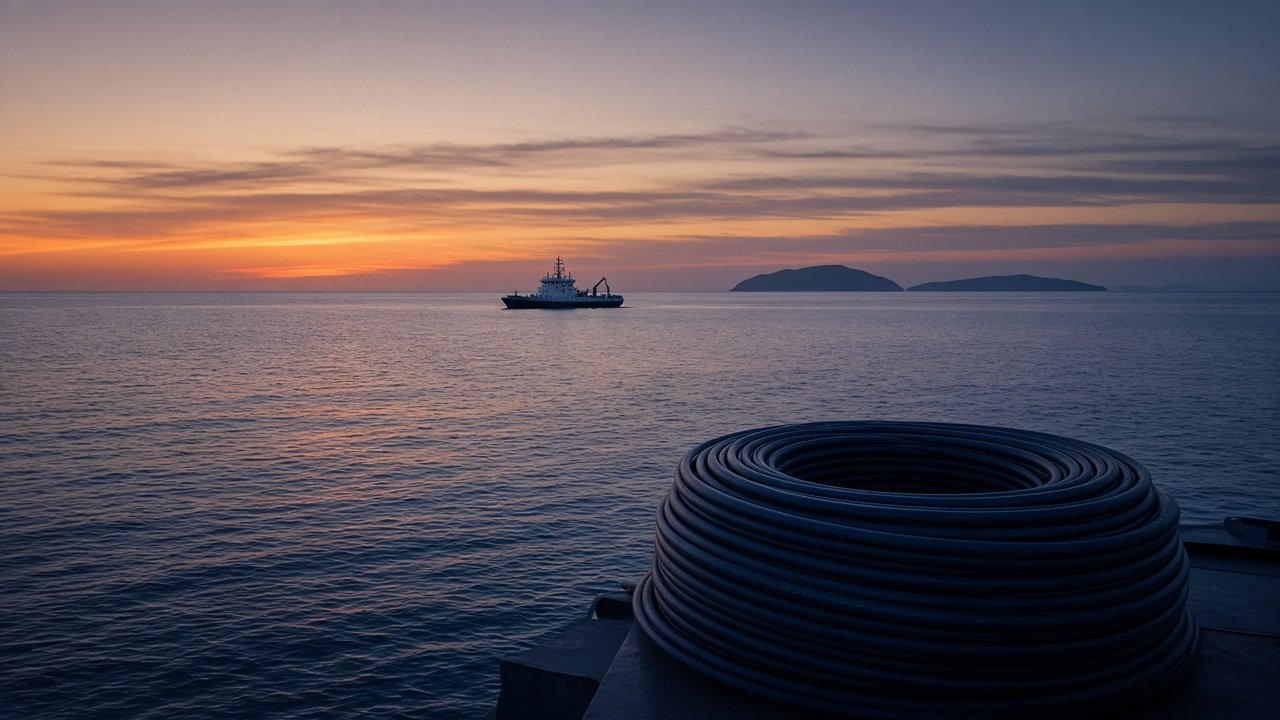
A French-flagged ship is about to resume seabed surveys for the Great Sea Interconnector, a planned 900-km power cable between Crete and Cyprus. Turkey answered Greece's navigation notice with one of its own. Why a cable survey turns into a dispute over who owns the sea, what each side actually argues, why the economics are shakier than the politics, and what could happen next. Explainer with a short opinion section.
On Friday 6 November, Greece published a navigation warning, known as a Navtex, telling ships that a survey vessel would be working southeast of Crete until 6 March 2027. Within hours Turkey published its own warning, number 1105/26, calling the work “unauthorised” and saying part of the area lies on Turkey’s continental shelf (Cyprus Mail, To Vima).
The ship, the French-flagged Abeille Marengo, is not looking for gas. It is mapping the seabed for a power cable. So why does a survey for an electricity line set off a diplomatic duel between two NATO members?
The project in brief
The Great Sea Interconnector (GSI) is a planned direct-current cable of roughly 900 km between Korakia in Crete and Kofinou in Cyprus, with an initial capacity of 1,000 megawatts and an estimated cost of about €1.9 billion, of which the EU has granted €657 million (Politis, Philenews). Its purpose is simple: Cyprus is one of the few electrically isolated systems in the EU, with no link to any neighbouring grid, and it still burns imported heavy fuel oil and diesel for much of its power (Venizelou and Poullikkas, 2025). An island grid like that cannot import cheap power on a calm day or export surplus solar at noon; in recent years Cyprus has had to curtail a growing share of its solar output, at times more than 60% on a given day, according to the same paper.
In August 2026 the French infrastructure investor Meridiam bought 66% of the project company, while Greece’s grid operator IPTO kept 34% and the technical lead (IPTO Holding). Athens openly saw the French presence as a safeguard in case of new trouble with Turkey (eKathimerini).
Why a survey is not “just a survey”
The cable has to cross deep water south of the islands of Kasos and Karpathos. Who has rights to that seabed is exactly what Greece and Turkey disagree about.
Under the UN Convention on the Law of the Sea (UNCLOS), a coastal state has a “continental shelf” (the seabed beyond its 12-mile territorial sea) and usually an “exclusive economic zone” above it, with exclusive rights to explore and exploit resources there (UNCLOS Part VI). Greece and Cyprus say islands generate these zones like any coast, so their zones meet south of Kastellorizo and the cable runs only through Greek and Cypriot areas (Cyprus Mail).
Turkey is not a party to UNCLOS. Its foreign ministry argues that islands do not automatically get full zones, that islands lying off another state’s coast should get limited effect, and that maritime boundaries must be “equitable”, not drawn by a median line (Turkish MFA, 2020). On that reading, much of the sea between Crete and Cyprus belongs to Turkey’s shelf, whose outer limits it sent to the UN on 18 March 2020, after its 2019 maritime deal with Libya’s Tripoli government (Philenews).
So each warning is a legal statement. If a ship works there with only Greek permission and Turkey says nothing, Athens gains a precedent. If the ship asks Ankara first, Turkey gains one. Neither side wants to lose a point that could matter in some future court case or negotiation.
A twist in the law that both sides underplay
Here is the part that rarely makes headlines. Article 79 of UNCLOS says that all states may lay cables on another state’s continental shelf, and that the coastal state “may not impede” them, subject to reasonable measures for its own resource rights (UNCLOS Part VI). Consent over the route is required for pipelines, not cables, under the text.
Two Greek scholars, Petros Liakouras and Constantinos Filis, have pointed out that this cuts both ways (eKathimerini, 2025). Turkey, they argue, is trying to turn a freedom into something it must approve. But they also criticise Athens for defending the 2024 survey by saying the area is Greek shelf under its 2020 deal with Egypt, rather than relying on the freedom to lay cables. In their view that makes the project hostage to the boundary dispute it could have stayed out of. Turkish legal scholars, by their account, reply that route surveys can touch on shelf rights and therefore need the coastal state’s say. This is a genuine legal disagreement, not a settled question.
What happened last time
In summer 2024 an Italian survey ship, Ievoli Relume, worked between Kasos and Karpathos while Turkey sent up to five warships just outside Greek territorial waters, and Greece sent a frigate to shadow them (eKathimerini). Sources differ slightly on the month: Greek reporting at the time dates it to July, while the 2025 article above says August. The ship did finish its pass through that strait, according to Kathimerini and the Greek grid operator (Kathimerini). But the wider surveys then stopped, and stayed stopped for about two years (eKathimerini). Both things are true: the ship was not driven off, and the project still froze.
What Turkey actually says
It would be lazy to read Ankara only as a spoiler. On 21 October, Foreign Minister Hakan Fidan said Turkey has “no objections” to the cable itself. What it wants is written notice with coordinates before ships survey disputed waters, so that “the status quo” is not changed (To Vima). He also restated an economic argument: Cyprus could buy electricity, water and gas from mainland Turkey, about 70 miles away, rather than through a 2,000-km route funded by EU money. After last week’s warnings, Fidan told Kathimerini that “everything is normal, everything is fine,” and Turkey’s reaction so far has been a counter-warning and drones overhead, not warships (Politis).
Greek and Cypriot officials see the “just notify us” request as the whole problem: notification today becomes consent tomorrow. Turkey also has its own plan, announced in May, for a power cable and gas pipeline to the Turkish Cypriot north, though Ankara admits the cable faces obstacles from EU rules (Cyprus Mail). Seen from Ankara, the GSI is one of several projects that would tie Cyprus’s energy future to Europe while shutting Turkey out.
The economics are the weaker leg
Even if every ship sails in peace, the cable has a money problem. Cyprus’s energy regulator told parliament on 20 October that the €1.9 billion figure “is no longer valid”, the final cost will be higher, and the contractor Nexans has signalled a one-year delay to 1 January 2031. After the EU grant, Cyprus would pay about €749 million of the investment and Greece about €440 million, recovered mainly through consumers’ bills (Sigmalive). Cyprus’s finance minister said in September that he is “not sure” prices will fall (Cyprus Mail), and a 2024 review by Charles River Associates for the Cypriot government found it “unclear” whether the GSI would lower power costs or is the best way to meet renewable targets (Cyprus Mail).
The closest comparison is Malta, linked to Sicily by a 200-megawatt cable in 2015. A peer-reviewed study found that the cable “does not necessarily lower electricity prices” for Maltese consumers; the result depends on oil prices, local generation and market design (Ries et al., 2016). The benefits that are clearer are security of supply and the ability to use more solar without wasting it.
What could happen next
- Quiet completion. Turkey keeps to warnings and drones, and the survey runs to March. Philenews reports that Greek and Cypriot sources think this most likely, citing diplomatic groundwork with France, the EU and the US (Philenews).
- A 2024 repeat. Warships shadow the ship off Kasos. Work may continue, but contractors and lenders price in the risk, and costs rise further.
- A quiet compromise. Some form of notice reaches Ankara without either side calling it consent. That would save the project but blur the precedent both capitals care about.
- The money fails first. Surveys finish, but cost overruns and Cypriot hesitation over payments, of €25 million a year promised once the Navtex was issued (Philenews), stall the cable anyway.
Opinion: the sea fight is real, but the bill matters more
I think Greece is right that a state should not need a neighbour’s permission to lay a cable on a seabed that, under the treaty most of the world has signed, is its own, and the treaty’s text protects cable laying far more than it gives anyone a veto. But I don’t think “Turkey is the only obstacle” is honest. Ankara’s demand is modest in form and large in intent, and Athens’ insistence on never notifying is also about precedent, not about the cable.
The deeper risk is less dramatic. A project sold as cheaper, cleaner power for Cypriot households now has an unknown price, a slipping date and studies that cannot promise lower bills. If those households end up paying more for a strategic symbol, the people of Cyprus will have lost even if no warship ever appears. The best outcome is a cable that is built calmly, priced honestly, and judged by what it does to ordinary bills, not by who won the battle of the Navtex.
Sources
- Cyprus Mail: GSI seabed surveys announced as Turkey issues counter-Navtex (6 November 2026)
- Philenews: Turkey challenges Greek notice for Crete-Cyprus cable survey (7 November 2026)
- Politis: GSI reactions closely watched as Turkey responds to NAVTEX notices (9 November 2026)
- To Vima: 'Dueling NAVTEXs': Turkey issues counter-notification challenging Greek authorization for cable surveys
- To Vima: Fidan on GSI: Turkey wants written notice of sea surveys (21 October 2026)
- ADMIE (IPTO) Holding: Notification regarding the Great Sea Interconnector special purpose vehicle (6 August 2026)
- Politis: A French stamp now marks the Great Sea Interconnector
- eKathimerini: Power link gains French shield (August 2026)
- Kathimerini: Italian research vessel leaves Kasos after completing its work (24 July 2024, in Greek)
- eKathimerini: Tensions rise again in the Aegean (July 2024)
- United Nations: UN Convention on the Law of the Sea, Part VI (Continental Shelf)
- Turkish Ministry of Foreign Affairs: Outstanding issues in the Eastern Mediterranean and the Aegean Sea, Turkey's views and policies (February 2020)
- Petros Liakouras and Constantinos Filis: The cable and its pitfalls, eKathimerini (29 March 2025)
- Cyprus Mail: No confirmation of reports of navtex for interconnector surveys (6 August 2026)
- Sigmalive: Great Sea Interconnector cost unknown as delay grows (October 2026)
- Cyprus Mail: GSI to cost a lot more than initially projected (8 September 2026)
- Cyprus Mail: Study questions if power costs for consumers will fall (16 December 2024)
- Venizelou and Poullikkas: Navigating the evolution of Cyprus' electricity landscape, Energies 18(5), 2025
- Ries, Gaudard and Romerio: Interconnecting an isolated electricity system to the European market: the case of Malta, Utilities Policy 40, 2016
- Cyprus Mail: Turkey resurrects gas pipeline and electricity cable project with the north (20 May 2026)
Comments