 Isidora & Cos Explain
Drones Were Sent at a Substation, Not a Reactor. Why Can That Still Threaten a Nuclear Plant?
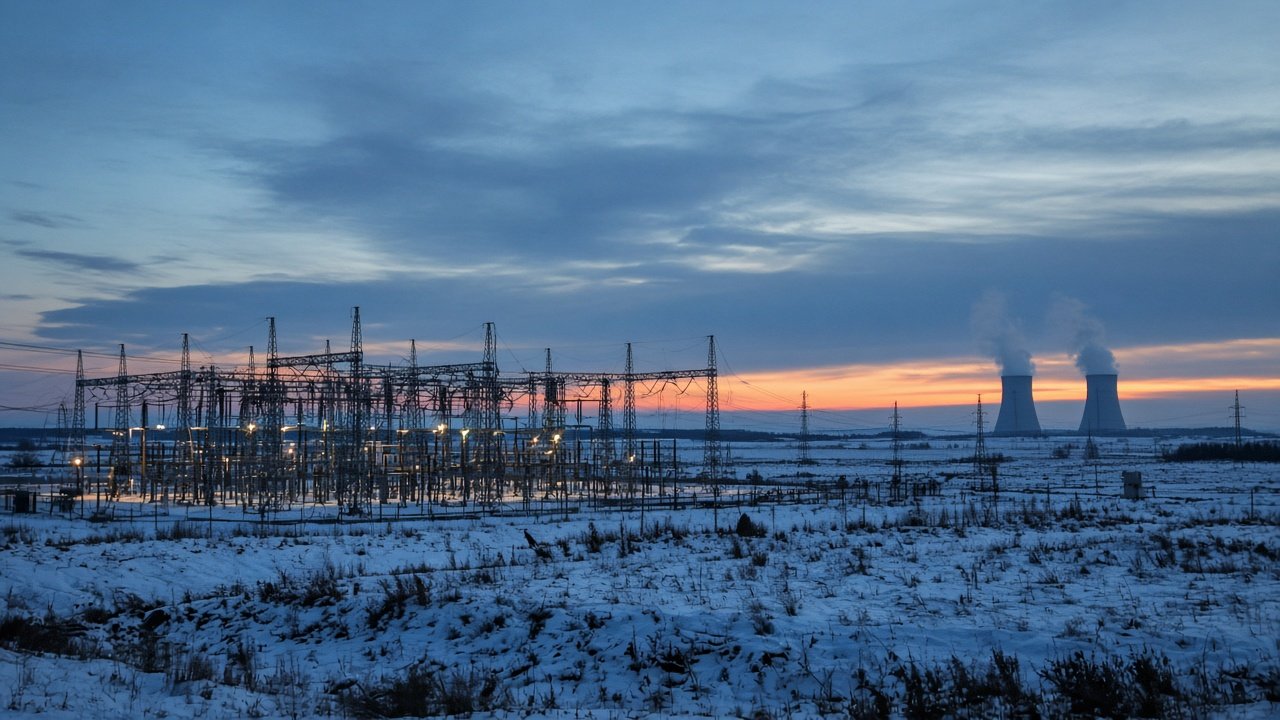
On 3 November Ukraine said Russia aimed three drones at a substation that keeps the Khmelnytskyi nuclear plant running safely. Nobody fired at the reactor itself, so why the alarm? The answer lies in a simple fact of physics: a reactor that has been switched off still needs electricity to stay cool.
During the night of 2 to 3 November, Russia launched what the Kyiv Independent called its biggest attack on Ukraine’s energy system this year: 289 drones, 17 ballistic missiles and 59 cruise missiles, according to Ukraine’s energy minister Denys Shmyhal. Among the targets, he said, were three drones aimed at a substation “critical to the stable operation” of the Khmelnytskyi nuclear power plant in western Ukraine. He called it a threat to “the nuclear safety of the whole of Europe” and reported it to the International Atomic Energy Agency (IAEA).
As of the evening of 3 November, no damage to the substation and no change in the plant’s operation had been reported. Russia’s defence ministry, for its part, said it had struck power plants and substations in three regions that supply electricity to Ukraine’s arms industry and armed forces, and did not mention Khmelnytskyi.
So why would a few drones aimed at electrical equipment, rather than at a reactor, worry nuclear engineers? The answer is less about war than about physics.
A reactor does not switch off like a light
When a reactor shuts down, control rods stop the chain reaction within seconds. But the fuel is full of radioactive fission products that keep decaying and keep producing heat. According to an explainer from MIT’s nuclear science department and standard reference figures, this “decay heat” is about 6.5% of full power at the moment of shutdown, around 1.5% after an hour and roughly half a percent a day later. It then falls only slowly, which is why spent fuel also has to sit in cooled pools for years.
Those percentages sound small until you translate them. Take, as an illustration, a large reactor producing 3,000 megawatts of heat: an hour after shutdown it would still be making about 45 megawatts, and a day later about 15, enough to keep boiling water steadily. If that heat is not carried away, the MIT explainer notes, the fuel cladding starts to oxidise rapidly at around 1,200°C and the fuel itself can melt at temperatures above 2,400°C.
Carrying that heat away needs pumps, valves, instruments and control rooms, and almost all of them run on electricity. A nuclear plant is a power station, but it is also a large consumer of power.
Where the power comes from
Normally, that electricity comes from the grid, through the plant’s switchyard and nearby substations. Substations step voltage up and down and connect the plant’s lines to the rest of the network, which is why the IAEA calls them “indispensable for maintaining secure off-site power supplies that support safety systems and reactor cooling functions.”
If the grid is lost, plants fall back on emergency diesel generators, and behind those on batteries. This layering is deliberate. Losing off-site power is a situation every plant is designed for; it is not, by itself, an accident.
The danger is what happens when the layers fail one after another. That is exactly what happened at Fukushima in 2011. The earthquake knocked out the off-site power lines and substation equipment, and the diesel generators started as designed, according to the IAEA’s technical report. Then the tsunami flooded the generators and switchgear. Japan’s environment ministry estimates that the core of Unit 1 went without cooling water for about 14 hours, and Units 2 and 3 for about 6.5 hours. Three reactors melted down.
In other words, a nuclear plant is safest when it has many independent ways to get power. Every substation that is damaged removes one of them.
What war has done to Ukraine’s margins
Shortly after the full-scale invasion in 2022, IAEA Director General Rafael Grossi set out seven “indispensable pillars” for nuclear safety during a war. Pillar four reads: “There must be a secure off-site power supply from the grid for all nuclear sites.”
The clearest illustration of what happens when it is missing is Zaporizhzhia, Europe’s largest nuclear plant, which Russian forces have held since March 2022. Its six reactors have been in shutdown since 2022, but they and their spent fuel pools still need cooling, and the plant draws that power over lines from the Ukrainian-held side of the Dnipro river. By September 2026, Grossi told the agency’s board, the plant had lost all off-site power 26 times since the start of the war, ten of them since June. The latest outage, which began on 20 August, lasted until 7 September, and at one point the site had only about ten days of diesel fuel left, the regulatory minimum. Power came back only after repairs made possible by an IAEA-brokered local ceasefire.
Who cuts those lines is itself disputed. The IAEA generally records outages as caused by “military activity” without naming a side. The Russian-run plant management has blamed Ukrainian shelling for damaging the equipment that feeds it, while a Greenpeace satellite analysis published in September 2026 found no evidence of the claimed Ukrainian attacks and attributed the outages to Russian military activity. Neither account has been independently confirmed by the IAEA.
The three plants Ukraine still operates, Khmelnytskyi, Rivne and South Ukraine, face a different problem. Their reactors are running, and when substations are hit they have to cut output to keep the grid stable. The IAEA has sent repeated missions to 19 substations it considers critical for nuclear safety; the latest, from 10 to 24 October, was followed days later by an attack on the Slavutych substation, which reportedly lost all its 330-kilovolt lines.
Why would anyone aim at that part of the grid? One reason is simple arithmetic. Ukrainian state media outlet UNITED24 says nuclear power provides 53–55% of Ukraine’s electricity, and up to 70% at peak times, so whoever wants to darken the country has to deal with the nuclear plants. The same outlet describes a document, presented to European partners as an intercepted Russian plan, for a campaign against the substations linking the three working plants to the grid. That document has not been independently verified and should be treated as an unconfirmed claim. Russia, for its part, does not say it targets nuclear safety at all; it says it hits energy that serves the war effort.
What the law says, and what it does not
International humanitarian law has a special rule for nuclear plants. Article 56 of Additional Protocol I to the Geneva Conventions says nuclear electrical generating stations shall not be attacked, even if they are military objectives, when that may release “dangerous forces” and cause severe civilian losses. The same protection covers other military objectives “in the vicinity” if attacking them could cause such a release.
But the rule has limits. Protection can cease if a plant provides power “in regular, significant and direct support of military operations” and attack is the only feasible way to stop it. And a substation miles away is not obviously “in the vicinity”. Russia’s defence ministry frames its strikes in exactly these terms, saying the facilities it hits power military-industrial enterprises. Ukraine and the IAEA argue that whatever the legal label, damaging the grid that feeds nuclear plants raises the risk of an accident that would not respect borders. In March 2026 the IAEA board passed a resolution calling attacks on the grid that feeds Ukraine’s plants “a direct threat to nuclear safety”, but only by 20 votes to 4, with 10 abstentions. The four against were Russia, China, Niger and, notably, the United States. Abstentions and no votes do not mean those states think grid attacks are safe; votes on Ukraine at the IAEA are also votes on who gets blamed, and many governments prefer not to take sides in a war far from home. But the split shows that the principle behind pillar four, however widely supported in words, is not yet a shared red line.
Nor is the risk only on one side. Ukraine has repeatedly struck Russian energy targets, and Russia says Ukrainian drones hit the Kursk plant’s auxiliary transformer in August 2025 and a cooling tower at Novovoronezh in October 2025. In both cases the IAEA reported normal radiation levels, and Grossi repeated that nuclear plants “should never be attacked”.
What could happen next
The most likely outcome of any single strike like that of 3 November is nothing dramatic: a line trips, a reactor reduces power, generators may start, repairs follow. The plants are built for that,, and Zaporizhzhia has come through 26 complete blackouts on its diesel generators.
The worrying scenario is accumulation: substations degraded faster than they are repaired, diesel stocks that cannot be replenished, staff exhausted, and then one more failure at the wrong moment. That is the chain Fukushima showed. The hopeful scenario is that the trilateral talks between Russia, Ukraine and the United States, which the Kremlin says will take place in Abu Dhabi on 10–11 November, produce what the IAEA has managed only locally so far: an agreement to leave the grid around nuclear plants alone.
Until then, the honest answer to “is it dangerous?” is that no single drone is likely to cause a disaster, but each one spends some of the safety margin that is supposed to be there for the day when everything else goes wrong.
Sources
- Ukrinform: Russia targets substation critical to stable operation of Khmelnytskyi NPP (3 November 2026)
- Kyiv Independent: Russia launches biggest mass attack on Ukraine's energy infrastructure this year (3 November 2026)
- UkrMedia: Russia sent three drones towards the substation at the Khmelnytskyi Nuclear Power Station
- EFE: Russia, Ukraine trade massive attacks on energy, infrastructure (3 November 2026)
- TASS: Russian forces deliver massive strike on energy facilities powering Ukrainian army
- MIT NSE Nuclear Information Hub: What is decay heat?
- IAEA: The Fukushima Daiichi Accident, Technical Volume 1
- Japan Ministry of the Environment: Factors of the accident, influence of the earthquake and tsunami
- IAEA: Director General statement to the UN Security Council (25 January 2024), the Seven Indispensable Pillars
- IAEA: Director General's introductory statement to the Board of Governors (30 January 2026)
- IAEA Board of Governors resolution GOV/2026/25 on unstable energy infrastructure in Ukraine
- IAEA: Update 334, Khmelnytskyy and Rivne reduce power after attacks on substations
- IAEA: Update 373, Director General statement on the situation in Ukraine (30 October 2026)
- OECD Nuclear Energy Agency: Ukraine, current status of nuclear power installations
- IAEA: Director General's introductory statement to the Board of Governors (7 September 2026)
- ANS Nuclear Newswire: Zaporizhzhia restores off-site power following IAEA-brokered local ceasefire
- UNITED24 Media: Why attacks on Ukraine's power substations could have consequences for nuclear safety worldwide
- Interfax: Equipment used for Zaporizhzhia NPP power supply damaged by shelling, plant says (3 October 2026, in Russian)
- Greenpeace Ukraine: Satellite analysis of power line outages at the Zaporizhzhia NPP (September 2026)
- Rubryka: IAEA board condemns attacks on Ukraine's energy infrastructure, but US, Russia, China and Niger oppose (6 March 2026)
- Anadolu Agency: Russian delegation to arrive in Abu Dhabi on Nov. 10-11 for trilateral Ukraine talks
- Wikipedia: Decay heat
- ICRC: Additional Protocol I (1977), Article 56, protection of works and installations containing dangerous forces
- Nuclear Engineering International: Drone hits Novovoronezh cooling tower (October 2025)
- France 24: Downed Ukrainian drone causes short-lived fire at Russian nuclear power plant (August 2025)
Comments