 Isidora & Cos Explain
Europe Wants Every Household Ready to Last 72 Hours Alone. Does a Survival Kit Actually Save Lives?
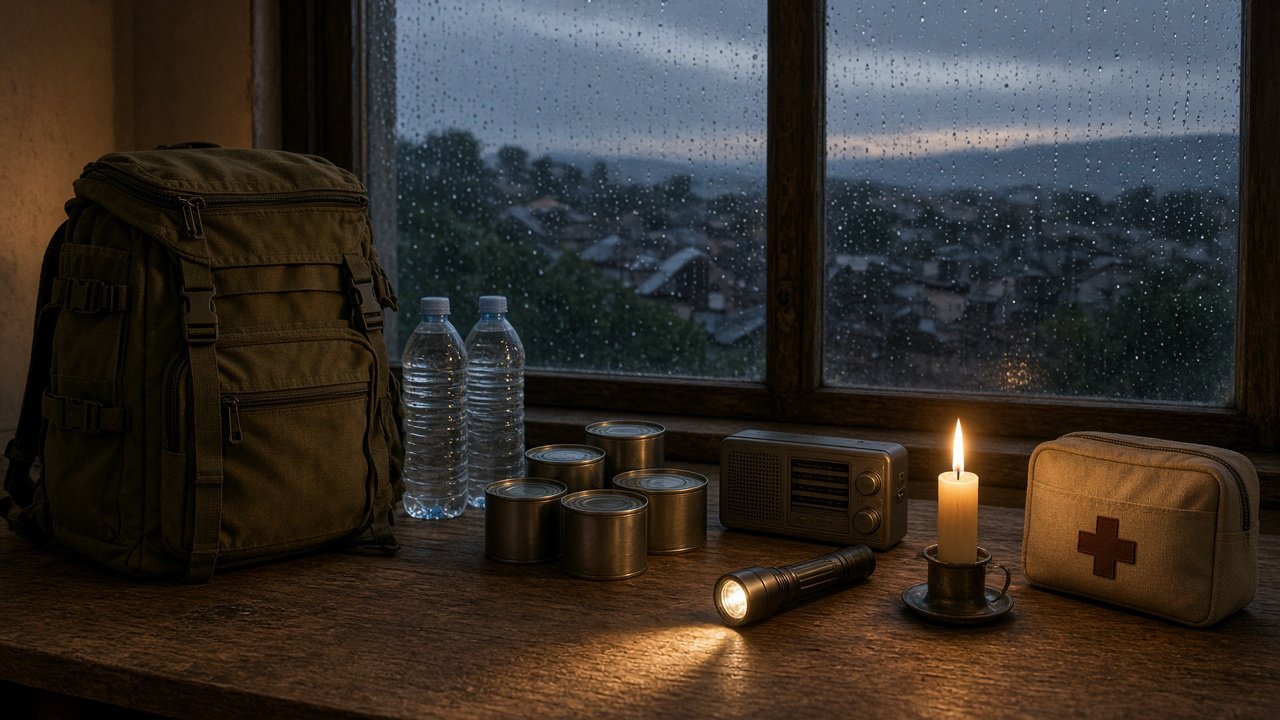
On 3 November the European Commission told governments to help every household get through the first three days of a crisis on its own. Japan, Britain and Sweden ask the same, or more. But the evidence that emergency kits save lives is thin, and the people least able to stock up are the ones most likely to die in a disaster.
On 3 November the European Commission published guidelines asking national governments to help every household get through the first 72 hours of a crisis on its own: water, food, medicines, cash, light, a way to hear the news, and a plan. The guidelines are not binding. They come in a package with three other pieces: teaching preparedness in early childhood and primary schools, making emergency planning work for people with disabilities, and communicating risk more clearly. The Commission also announced an annual EU Preparedness Day, with the first in October 2027.
It sounds like common sense, and in many ways it is. But it raises two harder questions. Do emergency kits actually save lives? And who can afford to keep one?
Why three days?
The guidelines give the reasoning plainly. Whatever the cause of a crisis, a flood, a cyberattack, a blackout or a war, its effects on a household look similar: no power, no water, no phone signal, empty shops. If most households can cover their own basic needs for the first three days, emergency services can concentrate on the people who cannot. The Commission stresses that this is “complementary to public emergency response”, not a replacement, and that there should be no single European kit; each country adapts the advice to its own risks.
The target is not new. The 2024 Niinistö report on Europe’s civilian and military readiness recommended it, and the March 2025 Preparedness Union Strategy promised these guidelines. What is new is the detail, and the admission, in a document on a citizens’ panel held earlier this year, that awareness of the 72-hour kit “varies greatly”, that in some countries it is “practically invisible”, and that it is unclear whether citizens or the state are responsible for it. The Commission says it will study preparedness among low-income groups and report next year.
Europe is not alone, and some ask for more
The 72-hour figure is close to an international standard. Japan’s government advises at least three days of water (three litres per person per day) and food, and says a week is desirable for a major disaster. According to the Seoul Economic Daily, citing Japanese broadcaster FNN, disaster minister Goshi Hosono planned an “urgent request” to the public this month along the same lines, with the Nankai Trough megaquake and a possible Mount Fuji eruption in mind. Britain’s Be Ready campaign, launched in late October according to the same report, also asks for 72 hours and tells people to build their kit gradually rather than buy it at once.
Sweden goes further. Its brochure In case of crisis or war, sent to 5.2 million households in 2024, says the government wants everyone to manage for at least a week without support, “because society’s resources are not enough for everyone at the same time”. That sentence states the logic of the whole policy more honestly than most: it is about triage.
How prepared are people now?
Not very. In the EU’s Special Eurobarometer 547, carried out in early 2024, only 37% of people said they felt well prepared for a disaster in their area, and 58% said they did not. Only 29% kept an emergency stock of food or drink, according to the EU’s civil protection network. And 39% said they had no time or money to prepare properly.
Money matters a great deal. People who struggle to pay their bills were far less likely to feel prepared (24%) than those who never do (39%). The sharpest picture comes from Denmark, which already asks households to manage for three days. In a 2025 Danish Red Cross survey of 3,415 people who had received its Christmas aid, two in three had no home emergency supplies, and 73% of those said they could not afford them. One respondent put it bluntly: she counts nappies to last until the end of the week, so extra tins and water are out of reach. For a household living week to week, a three-day stockpile is not a habit; it is a cost.
Does a kit actually save lives?
This is the uncomfortable part. The evidence that household kits reduce harm is thin. A study of 1,114 New York households after Superstorm Sandy found that having a kit, a plan and spare medication did not reduce the risk of bad outcomes; the authors told disaster managers to “consider the lack of evidence for preparedness” when spending money. A 2024 systematic review of 17 studies found no clear effect of education or support programmes on supplies or knowledge, and only a small effect on preparedness behaviour, with very low certainty.
That does not prove kits are useless. Disasters are hard to study: the Sandy study was a survey taken years later, and the people who prepare most may be exactly those who expect to be hit hardest, which would hide any benefit. What it does show is that the kit is easy to promote and hard to prove.
Real disasters suggest that what decides who lives or dies is often something else. In the Valencia floods of October 2024, according to an El País reconstruction, most of the 229 victims were already dead when the mobile phone alert went out at 20:11, and many drowned on ground floors, in garages and in lifts. No grab bag would have saved them; a timely warning telling people to go upstairs might have. In the Iberian blackout of April 2025, by contrast, the kit idea worked as intended: card payments failed, and people rushed to buy candles, batteries and radios. Power was back within about a day, well inside the 72-hour window.
The people a kit cannot save
The highest risk is concentrated among people who cannot simply walk away from danger. After the 2011 earthquake and tsunami in Japan, an NHK survey reported by the Japan Disability Forum found the death rate among registered disabled people in affected coastal towns was about twice that of the general population. A wheelchair user does not need a better torch; she needs someone who knows where she lives and will come for her. The Commission’s disability guidelines recognise this, which is to its credit.
There is one group the guidelines do not name. The systematic review above notes that for women living with a violent partner, a written emergency plan can increase the danger if the abuser finds it. Advice written for an ordinary family can be risky in a home where the family is the threat. Inclusive preparedness should include women’s shelters and domestic-violence services in planning, not only fire brigades.
Children are another case. The Commission wants preparedness taught from kindergarten, “without creating fear or anxiety”. That is the right instinct; the question is whether schools get trained staff and time, or only a leaflet.
Is it preparation, or fear?
Critics see a darker side. The initial video by EU preparedness commissioner Hadja Lahbib in March 2025, which showed her pulling a Swiss army knife and playing cards from a handbag, was widely mocked. The more serious objection is about framing. Iain Overton of the charity Action on Armed Violence told Anadolu that governments risk a “self-reinforcing cycle of fear” in which warnings of war justify higher military spending, and that resilience against floods, cyberattacks and pandemics should not be sold as preparation for imminent war. He accepts that Britain should be better prepared for disruptions; his point is the framing, not the water bottles.
Governments have their own reasons. Europe has seen sabotage of undersea cables, cyberattacks and, in Ukraine, a full-scale war on the power grid. Ukraine shows what preparedness looks like when it is real, and it is not only household kits: by January 2026 the government said it had 6,908 “Invincibility Points” across the country, with 2,703 more in reserve, where people can get heat, power and a connection during blackouts. Self-reliance worked because the state built a floor under it.
A view from outside Europe
For much of the world, 72 hours without the state is not a scenario; it is ordinary life. In 2025, the UN reported that only 60% of countries had a multi-hazard early warning system, with small island states (43%) and the least developed countries furthest behind, and that disaster deaths are nearly six times lower in countries with comprehensive systems. That figure is a reminder of where the biggest gains lie: in warnings, and in the public systems behind them.
My view
A three-day stock of water, food and medicine is cheap insurance for those who can afford it, and the EU is right to say so calmly and without a single shopping list. But the evidence points elsewhere for saving lives: early warnings that tell people exactly what to do, registers of people who cannot evacuate alone, and help for those who cannot afford to stock up. The test of this policy will not be how many grab bags are sold. It will be whether, in the next flood, someone knocks on the door of the woman in the wheelchair on the ground floor, and whether the family counting nappies has been given what it needs. If the guidelines lead governments there, they will matter. If they become a way to hand the problem to households, they will not.
Sources
- European Commission: Commission takes new steps to prepare Europeans for growing crisis risks (3 November 2026)
- European Commission: Guidelines on Population Preparedness under the EU Preparedness Union Strategy (C(2026) 8250)
- Council of the EU: Staff working document on the Citizens' Panel recommendations (ST 15243/26 ADD 5)
- European Commission and High Representative: EU Preparedness Union Strategy, JOIN(2025) 130
- Sauli Niinistö: Safer Together, report on strengthening Europe's civilian and military preparedness (2024)
- Verian: Almost six in ten Europeans feel they are not well prepared for disasters (Special Eurobarometer 547 analysis)
- UCP Knowledge Network: New Eurobarometer on disaster awareness and preparedness of EU citizens
- Danish Red Cross: Many vulnerable people cannot afford home emergency supplies (17 February 2025)
- Swedish Civil Defence and Resilience Agency: The brochure In case of crisis or war
- Prime Minister's Office of Japan: Disaster preparedness, what you can do in advance
- Seoul Economic Daily: Japan to urge citizens to stockpile three days of food and water (27 October 2026)
- UK Government: Be Ready for emergencies
- The Journal: The EU wants us all to have 72-hour survival kits to hand (March 2025)
- Anadolu Agency: War preparedness or fearmongering? What's behind the West's emergency readiness push? (4 November 2026)
- Clay et al., Does Preparedness Matter? Household preparedness and outcomes during Superstorm Sandy (2019)
- Amberson, Heagele et al., Interventions for improving household disaster preparedness: systematic review and meta-analysis (2024)
- Japan Disability Forum: The Great East Japan Earthquake and persons with disabilities, why is the mortality rate so high?
- El País: How, where and when the 229 victims of the DANA died (26 October 2025)
- France 24 / AFP: Candles and radios in demand in Spain as blackout lessons sink in (29 April 2025)
- ENTSO-E: Final report on the grid incident in Spain and Portugal on 28 April 2025
- WMO and UNDRR: Global Status of Multi-Hazard Early Warning Systems 2025
- UNDRR: Early warning systems reach new heights, but critical gaps jeopardize global progress (12 November 2025)
- Interfax-Ukraine: Svyrydenko orders uninterrupted operation of Invincibility Points (10 January 2026)
Comments