 Isidora & Cos Explain
Poland Sent Police to Its Constitutional Court. Can You Restore the Rule of Law by Bending It?
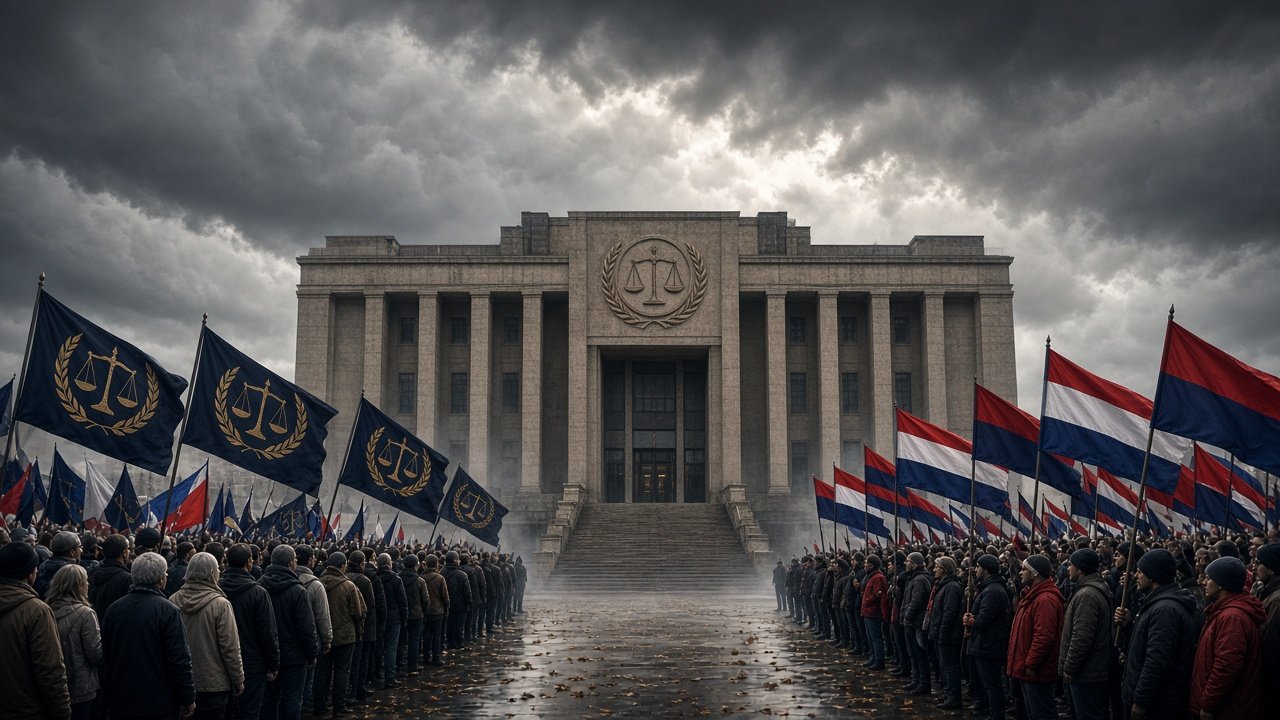
Poland's government has suspended the leaders of a court that European judges say is unlawfully composed, and police now guard the building. Both sides claim to defend the law. Here is how the deadlock was built, why it is so hard to undo, and what can go wrong either way.
On the evening of 30 October, riot police took up positions around Poland’s Constitutional Tribunal in Warsaw. Inside, one judge had just announced that the court’s president and vice-president were suspended for a month. Outside, supporters of the opposition Law and Justice party (PiS) pushed at the barriers, and police detained three people. President Karol Nawrocki, on his way to Senegal, turned his plane around, and shortly before 1am on Saturday pushed his way through the police cordon into the building, saying that “a constitutional body was seized by force”. The court’s own account on X called the whole operation “a coup d’état”. Prime Minister Donald Tusk called it “restoring the rule of law”.
Both sides say they are defending the constitution. To see why, you need the eleven-year history of how the court was broken.
How the court was captured, step by step
The story starts in 2015, and neither side’s hands are clean. That October, the outgoing parliament, led by Tusk’s camp, elected five judges to the 15-member tribunal. Two of those seats only fell vacant after its term ended. In December 2015 the tribunal itself ruled that three of the five elections were valid and two were not.
The new PiS majority did not accept even the three. It elected its own judges to all five seats, and President Andrzej Duda swore in the PiS choices while refusing the three lawfully elected ones. In 2021 the European Court of Human Rights found that a bench including one of these replacement judges was not “a tribunal established by law”, and noted the government’s earlier refusal to publish judgments it disliked. In December 2025 the EU’s Court of Justice went further: in Commission v Poland it held that the tribunal as a whole no longer met the standard of an independent and impartial court, because of those three appointments and the irregular appointment of its president in 2016. The current president, Bogdan Święczkowski, was appointed by Duda in December 2024, from two candidates put forward by the court’s judges.
Meanwhile, in 2021, the court ruled parts of EU law and of the European Convention on Human Rights incompatible with the Polish constitution, rulings the EU court has now declared a breach of Poland’s obligations.
Why the new government could not just fix it
Tusk won the 2023 election promising to undo this. He has struggled for a simple reason: Poland’s president can veto laws, and both Duda and Nawrocki, who is backed by PiS, have used that veto to block reform. The government responded by refusing to publish the tribunal’s rulings in the official journal, which means they have no legal effect in its eyes. That has a real cost: a citizen who wins a case at the tribunal cannot be sure the state will treat the ruling as law, and PiS did the same when it refused to publish rulings it disliked in 2016.
This year the parliament began filling seats as PiS-era judges’ nine-year terms expired. Nawrocki swore in some of the new judges but refused four, who took their oath in parliament instead. In October the Venice Commission said the president’s refusal should not stop judges from taking office. But the tribunal’s leadership under Święczkowski, a former deputy justice minister under PiS, refused to let them sit. A fifth, Maciej Berek, was sworn in the same way on 14 October. According to Prawo.pl, the five, together with three judges sworn in by the president, now form a majority of the court.
What happened on 30 October
The longest-serving of the five, Anna Korwin-Piotrowska, issued the suspension orders. The legal basis cited was Article 130 of the law on ordinary courts, which allows a judge to be removed for up to a month when “the dignity of the court” demands it. At the same time Justice Minister and Prosecutor General Waldemar Żurek sent the tribunal five requests, 224 pages long, to lift the two judges’ immunity so they can be charged with obstructing their colleagues and abusing their office. “This court has become private property,” he told reporters.
The tribunal answered that Święczkowski “remains the president” and that Korwin-Piotrowska “is not a judge”. On the morning of 31 October Święczkowski tried again to enter the building.
The case against the government, from its own side
The sharpest criticism is not from PiS. Marcin Matczak, a law professor and long-time critic of the PiS-era court, wrote that he never expected to defend Święczkowski, but that the legal basis “does not exist, for a million reasons”. Article 130 is written for ordinary courts, which the justice minister supervises; constitutional judges, under Article 195 of the constitution, answer only to the constitution. By the provision’s own logic, he added, only the minister can suspend a court president, so in effect a minister has suspended a constitutional judge.
The Council of Europe’s Venice Commission, the body that advises democracies on constitutional law, has said twice that restoring the rule of law must itself respect the rule of law. In its December 2024 opinion it accepted that the three judges elected to occupied seats could be removed, but insisted that judges elected by the procedure the constitution prescribes, even by a partisan majority, are presumed legitimate and can only be removed through an individual, judge-led process.
The case for the government
Kim Lane Scheppele, a scholar of democratic backsliding, argued that this standard lets a government that captured courts “by law” keep its gains. If only the captured court can declare itself captured, nothing ever changes. Modern autocrats, she writes, rarely stage coups; they pass laws. On this view, breaking a national rule to restore compliance with European law that Poland signed is different in kind from what PiS did.
The government also has a practical point. The court’s leadership has kept a parliamentary majority’s judges out of office for months, and the president has vetoed legislative fixes. Foreign Minister Radosław Sikorski said the aim is simply to let “the majority of duly elected judges” make the tribunal work again.
What the other side fears, and why it is not just a pretext
Some of PiS’s protest is hypocrisy, but its core fear is real. PiS and Nawrocki accuse the government of using the rule of law to remove opponents from state institutions. A constitutional court exists to check a parliamentary majority. If that majority can pick the judges, block the old ones and prosecute the court’s leaders, the president is left as the only check. Voters seem to value that check: in a September CBOS poll, 51% approved of Nawrocki’s work, against 30% for the lower house of parliament. Only 23% rated the tribunal itself positively.
There is also a sovereignty argument that many readers outside Europe will recognise. Polish conservatives say a national constitution, not courts in Strasbourg and Luxembourg, should decide who sits on a national court. They are not alone in resisting European judges: Germany’s own constitutional court declared a ruling of the EU court “ultra vires” in 2020, and the PiS-era tribunal cited it. Legal scholars point out that the German court challenged one specific judgment, while Warsaw claimed a far broader right to ignore EU rulings. The difference is real, but the principle that a nation may push back against European courts is not a Polish invention.
Abroad, far-right figures such as Nigel Farage and Geert Wilders condemned the move; the US ambassador warned against escalation.
Not only a Polish problem
Elected majorities reshape courts far beyond Europe. In Pakistan, a November 2025 amendment moved constitutional cases to a new court, and two Supreme Court justices resigned in protest. Poland tests the question every such country meets later: once the referee has been captured, who may replace him, and by what rules?
Scenarios
The suspension holds. The new majority runs the court and starts issuing rulings the government recognises. Lifting the two judges’ immunity needs ten votes, two more than the new majority has, according to Prawo.pl. PiS will call every later ruling illegitimate, and polls cited by the Guardian give the populist right a chance of returning to power in 2027. It could then use the same tools in reverse.
A deal. Talks with Vice-President Sochański have already failed, according to Żurek, but a negotiated package with the president remains the only path that would leave no party able to claim a coup.
Escalation. Two rival courts whose rulings each side ignores, until the 2027 election decides.
Opinion
I think the government is right about the diagnosis and wrong about the method. A court that two European courts have found unlawfully composed cannot be treated as untouchable, and a leadership that keeps elected judges out of their seats is itself breaking the rules. But suspending the court’s president with a provision written for district courts, with police at the door, hands its opponents the strongest argument they have had in years. The rule of law is not a prize that the right side gets to keep. It is a set of methods, and it only survives if the losing side still believes the methods are fair.
PiS-era terms are now expiring, so time is already doing part of the work. The better path is narrower: let the five new judges sit on the strength of the Venice Commission’s view, and have any charges against the court’s leaders decided by a procedure their own lawyers can contest, not by a minister’s order. It is slower. It is also the only version that does not teach the next government how to do the same.
Sources
- BBC: Police deployed during stand-off over control of top Poland court
- AP: Polish president turns back plane during protests over court president's removal
- NBC News: Polish president turns back from Senegal trip as top court chief suspended
- AFP: Polish riot police deployed as deposed court chief sets off crisis
- Euronews: Polish president turns back mid-flight amid court 'coup d'état' claims
- Rzeczpospolita: TK, policja i Święczkowski. Co dzieje się w Trybunale Konstytucyjnym?
- Prawo.pl: Nowi sędziowie TK, zawieszenie Święczkowskiego, reakcja prezydenta Nawrockiego
- Rzeczpospolita: Prof. Marcin Matczak reaguje na wydarzenia w Trybunale Konstytucyjnym
- Constitutional Tribunal of Poland: judgment K 34/15 of 3 December 2015
- European Court of Human Rights: Xero Flor w Polsce sp. z o.o. v. Poland (2021), press release
- Court of Justice of the EU: Commission v Poland, C-448/23 (18 December 2025)
- Venice Commission: Opinion on the Constitutional Tribunal, CDL-AD(2024)035
- Venice Commission and DGI: Joint opinion on the status of judges in Poland (October 2024)
- Kim Lane Scheppele, Verfassungsblog: Blinded by Legality
- Notes from Poland: Polish parliament hosts swearing-in of constitutional court judges in defiance of president
- Notes from Poland: Polish constitutional court rejects four new judges
- Dawn: Justices Shah, Minallah resign following passage of 27th Amendment
- The Guardian: Riot police deployed to Poland's constitutional court after judge suspended
- Anadolu Agency: What's happening in Poland? (explainer)
- Council of Europe: execution of Xero Flor v Poland (case description)
- TVN24: Polish president appoints Bogdan Święczkowski as new head of Constitutional Tribunal
- German Federal Constitutional Court: PSPP judgment of 5 May 2020
- German Law Journal: The impact of the PSPP judgment on Poland
- Wprost: CBOS poll on the Constitutional Tribunal and the president (September 2026)
Comments