 Isidora & Cos Explain
Sea Drones Sank a Ship Off Bulgaria. Why Can't a NATO Country Stop Them?
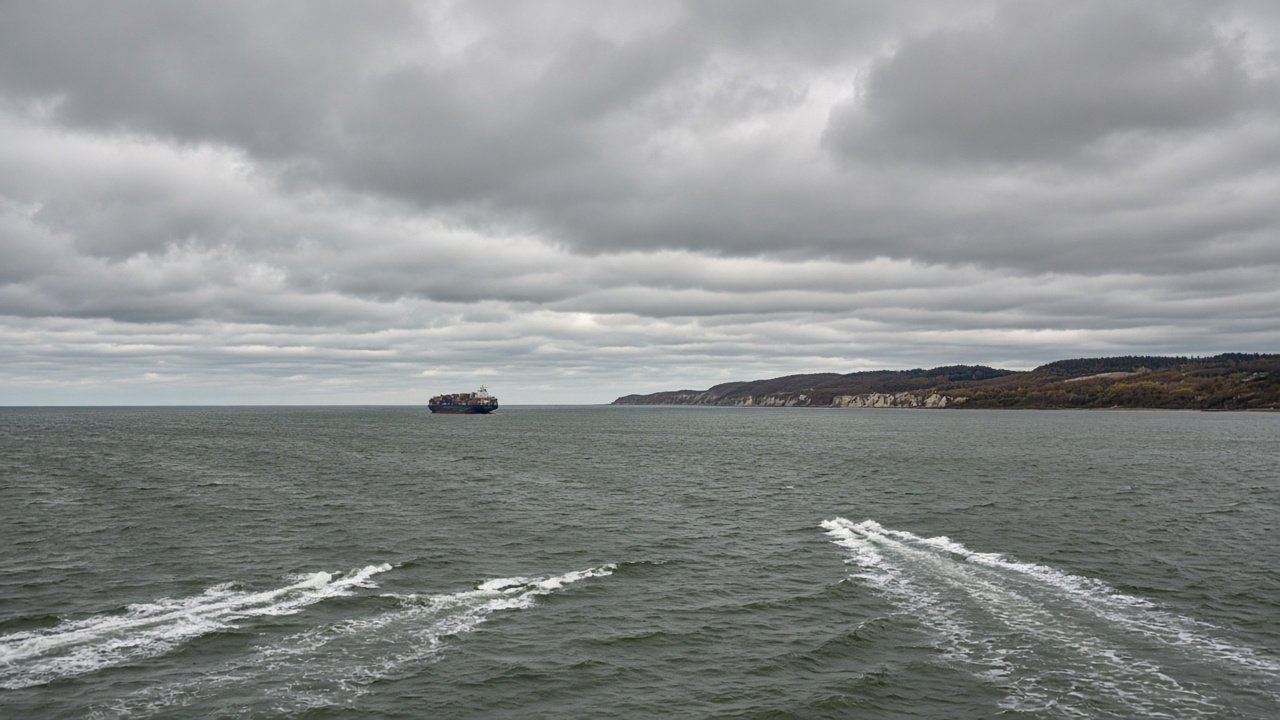
On 28 October three small uncrewed boats sank a container ship 21 nautical miles off Bulgaria, the fifth attack in Bulgaria's waters this month. Here is how cheap sea drones changed war at sea, why nobody has proven who sent these ones, why Bulgaria could not legally shoot, and who pays.
Shortly before 1 p.m. on 28 October, three small uncrewed boats struck the container ship Contship Jet about 21 nautical miles off Shabla, on Bulgaria’s northern Black Sea coast. The ship, Greek-owned, flying the Liberian flag and chartered to Israel’s ZIM, was sailing from Haifa to Constanța in Romania with 421 containers. All 18 crew, 14 Filipinos and four Ukrainians, were rescued. Around midnight the ship sank.
It was the fifth drone attack this month inside the exclusive economic zone (EEZ) of Bulgaria, a NATO and EU member. Why can small boats sink ships off its coast, and why does nobody officially know who sent them?
A cheap weapon that beat a fleet
A sea drone, or uncrewed surface vessel, is basically a fast small boat with a camera, a satellite link and explosives in the bow. The defence think tank RUSI describes it as the kind of craft that “can be built in a garage or small industrial unit”.
Ukraine, with almost no conventional navy, turned this into a strategy. In February 2024 its Magura V5 drones sank the missile corvette Ivanovets and the landing ship Tsezar Kunikov. According to the US Naval Institute’s journal Proceedings, a Magura V5 is thought to cost between $250,000 and $300,000, while one Russian ship it sank, the Sergey Kotov, was valued by Ukraine at about $65 million. A Ukrainian source quoted by the same journal counted 21 hits and 10 vessels destroyed by sea drones. These are claims by one side of the war that Russia does not confirm, but the result is visible: Russia moved almost all its major ships from Crimea to Novorossiysk and minimised patrolling.
Other militaries noticed: Chinese military analysts, according to the Jamestown Foundation, call it “countering the large and superior with the small and frugal”.
From warships to merchant ships
The problem is that a weapon this cheap does not stay aimed at warships. In June 2024 Yemen’s Houthis used an explosive drone boat against the Greek-owned bulk carrier Tutor in the Red Sea; it sank and one crew member was lost.
In the Black Sea, both sides have moved to commercial targets. In late 2025 Ukraine said its Sea Baby drones hit the sanctioned “shadow fleet” tankers Kairos and Virat, which carry Russian oil, inside Turkey’s EEZ. President Erdoğan called such attacks unacceptable, and Vladimir Putin threatened to “cut Ukraine off from the sea” and to strike ships of countries helping it. In 2026 Russian drones have hit foreign cargo ships near Ukrainian ports, and Ukraine says a Russian sea drone struck a vessel inside Odesa port in May.
So who sank the Contship Jet?
Officially, nobody knows. Bulgaria’s navy commander said the drones “could have been launched from anywhere” and that no Bulgarian forces were close enough to intercept them. The chief of defence said they approached from the east and that their origin still required analysis. Media reports that videos show a new type of drone are unconfirmed.
The earlier attacks give context. On 6 October the Alfa Watan and the Able were hit; the Alfa Watan sank and its crew, mostly Syrians, are presumed dead. On 13 October the HS Dignity sank with 10 crew missing, and the Ukrainian-owned Chelsea-3 was damaged (BBC, BNT). Bulgaria’s prime minister Rumen Radev then said there was no conclusive evidence against “either side”, but that “the logic suggests that the outcome benefits the Russian Federation”. His defence minister said he assumed the drones were Russian, because it would be “illogical” for Ukraine to hit its own ships. Russia’s ambassador said she had no information from Moscow and suggested a “provocation by a third party”. Moscow says in general that it targets ships carrying weapons and dual-use cargo to Ukraine; Kyiv says grain ships are being hit (BBC). Ukraine’s president said contacts with Bulgaria pointed to a Russian attack.
That is where the evidence stops. Suspicion is not proof, and Radev’s caution is understandable: a wrong accusation by a NATO state in wartime would be costly. Cheapness is part of the problem: a drone with no crew and no flag leaves little to trace, and every side has a ready explanation. The European Commission, without naming anyone, called the attacks a “dangerous and unacceptable escalation”.
Why Bulgaria didn’t shoot
The most surprising detail is legal. A French patrol aircraft spotted the drones and warned Bulgaria. But the chief of defence said: “We are not at war,” explaining that no action was taken because the drones stayed outside Bulgaria’s territorial waters, which reach 12 nautical miles. In an EEZ a coastal state has rights over fish, gas and seabed resources, but it is not sovereign there, and Bulgarian officials said they legally could not act against the drones while they were in it. Severe weather also limited Bulgaria’s own surveillance drones. Part of the limit is Bulgarian law, which is why the government now proposes amendments to expand the military’s peacetime powers and shorten the chain of command.
The same line shapes NATO’s response. Radev has ruled out invoking NATO’s Article 4 (consultations) or Article 5 (collective defence), since the attacks happened outside territorial waters. A surveillance system with a 150-km range was due to be deployed on 30 October, with strike capability envisaged later.
Geography adds a second limit. Under the 1936 Montreux Convention, warships of states outside the Black Sea may stay there for only 21 days and within a total tonnage cap. Since February 2022 Turkey has also closed the straits to warships of the belligerents. Turkey sees this as keeping the war contained; it also means the Black Sea’s security rests mainly on Turkey, Romania and Bulgaria, which since 2024 have run a joint mine-clearing group but no escort force.
What the law of war says
Even in a war, merchant ships are not fair game. The San Remo Manual, the main summary of the law of naval warfare, says a neutral merchant ship may be attacked only if, for example, it carries contraband and refuses to stop after warning, or makes an effective contribution to the enemy’s military action. The harder question is how far “contribution” stretches. Writing for the Lieber Institute at West Point, the German naval-law expert Wolff Heintschel von Heinegg argued that Ukraine’s strikes on shadow-fleet tankers are doubtful under the narrow test, because oil revenue helps the war only indirectly, but lawful under the wider American view that anything sustaining the enemy’s war effort is a target. He noted that few governments protested, apart from Hungary’s prime minister and Kazakhstan’s foreign minister, and that this silence may be stretching the rule.
That cuts both ways. If oil money that sustains Russia’s war makes a tanker a target, Moscow can claim that ships carrying grain, fuel or “dual-use” goods to Ukraine sustain Kyiv’s. Russia says exactly that. What it cannot easily explain is attacking ships with no warning, no inspection and no visible link to Ukraine, such as a container ship bound for Romania. Every widening of the target list puts more crews in danger.
Who pays
First, seafarers. Nine of the ten men from the Alfa Watan presumed dead were Syrian; the Contship Jet’s crew came mostly from the Philippines. Their countries have no part in this war.
Then everyone who ships through the region. After two Greek-managed tankers were hit in January, war insurance for Black Sea voyages nearly doubled. By August, brokers quoted around 2% of a ship’s value per voyage, and 3% to 5% for Ukrainian ports such as Odesa. When tankers loading Kazakh oil were hit in July, the shipbroker Gibson reported that cargo war cover rose roughly fivefold and that Kazakhstan had to briefly cut production. A war between two countries raises costs for others, including buyers of Black Sea grain and oil in Africa, the Middle East and Asia.
What could happen next
- A naval truce. It has been tried. In March 2025 the US announced separate understandings with Russia and Ukraine on safe navigation, but Moscow said it would apply only after sanctions on its agricultural bank and trade finance were lifted (Reuters). Moscow calls that a fair price for giving up leverage; Kyiv and the EU see sanctions relief under pressure. A truce is still the cheapest outcome for everyone at sea.
- Littoral states arm up. Bulgaria, Romania and Turkey extend surveillance, change laws to let navies act in their EEZs, and perhaps escort convoys. This needs ships they mostly lack, and risks a direct clash with the drones’ operators.
- A strike inside territorial waters. Five attacks have come close. One a few miles further west would put NATO’s Article 4, and possibly Article 5, on the table.
- The new normal. Attacks continue at a low rate, insurers price them in, some owners avoid the route and others take the higher freight, as Gibson already reported for oil tankers. In my judgement this is the most likely path while the war on land continues.
A weapon that costs as much as a small house can now sink a ship, sometimes with no clear sender. The protection of merchant shipping relied on two things: that attackers could be identified and held responsible, and that only a few states could reach ships far from their coasts. Sea drones weaken both. Patrol boats and new laws can reduce the risk off Bulgaria, but only an agreement between the two belligerents can remove it, and that agreement is tied to the much harder questions of the war itself.
Sources
- AP: Vessel hit by drones off Bulgaria's Black Sea coast sinks (29 Oct 2026)
- BTA: Contship Jet sinking prompts pollution checks and calls for allied support (29 Oct 2026)
- BTA: Fifth ship suffers drone attack in Bulgaria's exclusive economic zone (28 Oct 2026)
- Radio Bulgaria: Rear Admiral Mihaylov, drones' origin in Black Sea ship attack unknown (29 Oct 2026)
- Bulgarian Ministry of Transport: The 18-member crew of Contship Jet is rescued (28 Oct 2026, Bulgarian)
- The Maritime Executive: Zim confirms loss of containership attacked in Black Sea off Bulgaria (29 Oct 2026)
- BNT: Chronology of the attacks in the Black Sea (28 Oct 2026, Bulgarian)
- BBC: Bulgaria summons Russian ambassador after ship sinks in Black Sea drone attack (13 Oct 2026)
- Kyiv Post: Russia behind drone strikes on ships off Bulgaria, Zelensky says, as Radev rules out invoking NATO articles
- RUSI: Uncrewed platforms have been critical to Ukraine's success in the Black Sea
- USNI Proceedings: Ukraine's Magura naval drones, Black Sea equalizers (Sept 2025)
- USNI Proceedings: Step by step, Ukraine built a technological navy (May 2025)
- Reuters: Salvage firm confirms sinking of Greek-owned Tutor struck by Houthis (19 Jun 2024)
- Reuters: Ukraine hits two Russian 'shadow fleet' oil tankers with naval drones (29 Nov 2025)
- Reuters: Turkey's Erdogan says attacks on Black Sea commercial ships unacceptable (1 Dec 2025)
- Reuters: Putin threatens to 'cut Ukraine off from the sea' after attacks on tankers (2 Dec 2025)
- Reuters: Russian drone strikes foreign cargo ship near Ukraine Black Sea port (5 Mar 2026)
- Interfax-Ukraine: Russia's USV attacks sailing frigate Druzhba in Odesa seaport
- ICRC: San Remo Manual on International Law Applicable to Armed Conflicts at Sea (1994), paras 67-71
- The Insurer: Upward pressure remains on Black Sea marine war rates (19 Aug 2026)
- Reuters: Black Sea war insurance rates jump after tanker attacks (13 Jan 2026)
- SAFETY4SEA: Gibson, Black Sea drone strikes disrupt crude exports and lift war risk premiums
- Reuters: Turkey warns countries not to pass warships through straits (28 Feb 2022)
- Montreux Convention Regarding the Regime of the Straits (1936), English text
- Reuters: Turkey, Romania, Bulgaria sign deal to clear floating Black Sea mines (11 Jan 2024)
- The White House: Outcomes of the United States and Russia expert groups on the Black Sea (25 Mar 2025)
- Reuters: Russia says food and fertiliser sanctions must be lifted for Black Sea deal (25 Mar 2025)
- Lieber Institute West Point: Wolff Heintschel von Heinegg, The Ukrainian attacks against Gambian-flagged oil tankers in the Black Sea (8 Dec 2025)
- Jamestown Foundation: PLA insights from Ukraine's asymmetric USV operations
Comments