 Isidora & Cos Explain
The UN Has Counted Harm to Children in War for 30 Years. Why Is the Worst Year the Latest?
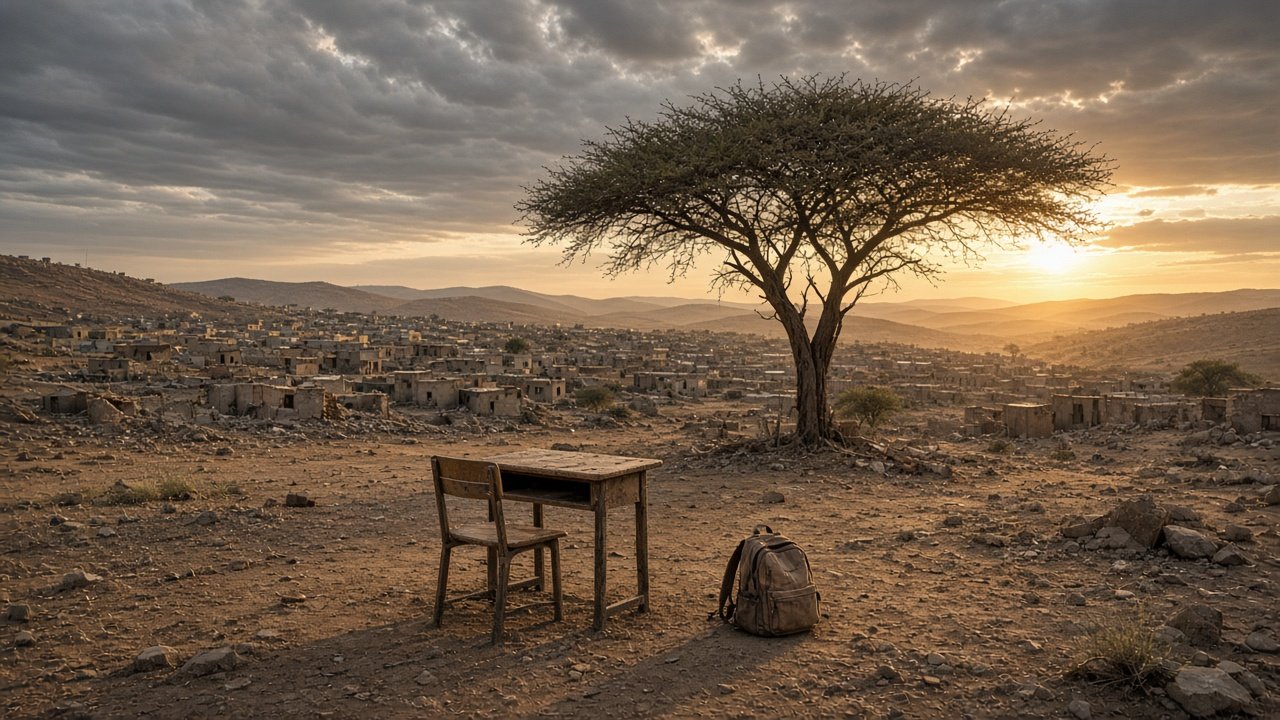
On 26 October 2026 the UN Security Council marks 30 years of its mandate on children and armed conflict, just months after the UN verified a record 24,174 children harmed in 2025, mostly by government forces. Where the mandate came from, what its 'list of shame' and action plans actually do, what the evidence says about whether naming works, why states from Saudi Arabia to Russia and Israel contest it, and what a shrinking UN budget means for the monitors. Explainer with a short opinion section.
Today, 26 October 2026, the UN Security Council holds a meeting to mark 30 years of its mandate on children and armed conflict. It is an awkward birthday. Four months ago the UN published its annual report for 2025, and it was the worst in the mandate’s history: 38,558 verified grave violations against 24,174 children. For the first time, government forces, not rebel or militant groups, were the main perpetrators.
So what has three decades of work actually achieved, and why does the curve point the wrong way?
Where the mandate came from
In 1996 Graça Machel, a former education minister of Mozambique, delivered a UN study on the impact of armed conflict on children. Its advisers came from Tanzania, Nigeria, South Africa, India, Colombia, Sudan, Sweden and the United States, among others, and its message was that children were no longer collateral to war but often its targets. The General Assembly answered with resolution 51/77, which created the mandate and a Special Representative; the first, Ugandan diplomat Olara Otunnu, was appointed in 1997.
The Security Council then built tools on top. In 2001 it asked the Secretary-General to annex a list of parties that recruit children, the document now known informally as the “list of shame”. In 2005, resolution 1612 created a Monitoring and Reporting Mechanism: UN teams on the ground who verify cases one by one. The monitors track six “grave violations”: killing and maiming, recruitment and use, sexual violence, abduction, attacks on schools and hospitals, and denial of humanitarian access. The first five can get a party listed; denial of aid is reported but is not, on its own, a reason for listing. A treaty, the Optional Protocol on the involvement of children in armed conflict, now has 173 states parties.
What the tools do
The mechanism works by a simple bargain. A party that is listed can get off the list by signing an “action plan” with the UN, a concrete programme to stop the violation, release children and change its rules, and then carrying it out. According to Security Council Report, 38 action plans have been signed since the mandate began, and 12 were fully implemented, leading to delisting. More than 220,000 children have been released from armed forces and groups. In 2025 alone, 13,112 formerly associated children received protection or reintegration support, and parties made about 40 new commitments in places including Somalia, Ukraine and Colombia.
Those are real children who went home. But 12 completed plans in three decades is also a measure of how hard the bargain is to close.
Why 2025 was the worst year
The 2025 report counts the most verified violations in Israel and the Occupied Palestinian Territory (12,445), the Democratic Republic of the Congo (4,114), Nigeria (2,560), Myanmar (2,203) and Somalia (2,195). Three of the five are in Africa, which is one reason the African Union appointed its own special envoy for children in armed conflict, Gambian diplomat Jainaba Jagne, in February 2026; she is expected to brief the Council today. Killing rose 34% on the previous year, to 6,266 children, with 7,958 maimed. Most child casualties came from explosive weapons used in towns and cities. The report also flags the growing use of artificial intelligence in targeting as a new risk, and counts 1,667 children detained for alleged links to armed groups or for “national security reasons”. The governments holding them cite security; the UN insists these children should be treated first as victims.
Three things explain much of the trend. First, wars moved into dense cities, where air and artillery strikes hit homes and schools. Second, state armies, which have more firepower than militias, were fighting more of them. Third, the number is partly a measure of monitoring: the UN itself warns its figures “do not represent the full scale” of violations, because access is blocked in many places. A record could reflect better counting in some wars and worse reality in others; the report cannot fully separate the two.
Does naming and shaming work?
The evidence is mixed, and it is thinner than the mandate’s importance deserves. A small quantitative study of the annual reports from 2013 to 2018, a 2019 bachelor’s thesis at Malmö University, found a “convincing link” between listing state actors and those states adopting child-protection measures, but a weak link for armed groups. That is a student work, not peer-reviewed research, so treat it as a hint rather than proof. Earlier legal scholarship, notably Conrad Nyamutata’s 2013 article, questioned whether shaming changes behaviour at all and argued for engagement instead.
The logic is intuitive. A government that cares about its reputation, its arms purchases or its peacekeeping contracts has something to lose from being listed alongside militias. An armed group that does not seek international recognition has far less to lose, which may explain why the effect looks weaker there.
Why the list is fought over
That reputational sting is exactly why powerful states push back. In 2016, Secretary-General Ban Ki-moon removed the Saudi-led coalition in Yemen from the list days after publishing it, saying he had to weigh “the very real prospect that millions of other children would suffer grievously” if countries de-funded UN programmes. Saudi Arabia denied making threats and called the casualty figures “wildly exaggerated”. Ban also said states objected to being listed alongside terrorist groups. His successor, António Guterres, answered that complaint in 2017 by splitting the list in two: parties that had taken measures to protect children, and parties that had not. Human Rights Watch called the result a “double standard”, noting the Saudi-led coalition was credited with measures while the UN still attributed 670 child casualties to it, and that Israel, Iraq, Sudan’s government and parties in Ukraine were left off despite the report’s own findings.
When Russian forces were added in 2023 over Ukraine, Moscow called it a “biased political decision” based on “pro-Western sources”, asked why Ukrainian forces were not listed, and pointed to what it called silence over children harmed in US-led wars and over Israel. When Israeli forces were added in 2024, Israel’s ambassador called it “shameful”, while Palestinian officials called it overdue.
Listed governments also make a substantive case: that the figures are exaggerated, as Riyadh said, or that they take, in Moscow’s words, “systematic measures to minimise civilian casualties”. These objections should not be waved away as pretexts. Verification in active war zones is hard, and the charge of selectivity has been made from opposite directions: rights groups accused the UN of sparing Israel and the Saudi-led coalition, while Russia accuses it of sparing Ukraine and Western armies. Ukraine and its supporters, for their part, raise the forced transfer of Ukrainian children to Russia; 16 statements at the June 2025 debate did so. At that debate, many states from every region asked for listing decisions based on “transparent, objective criteria”. The danger runs both ways: a list that bends to pressure loses its authority, but a list seen as one-sided gives listed states an excuse to ignore it.
The money problem
The newest threat is budgetary. A July 2026 survey by the Global Protection Cluster found that about 87% of child-protection organisations had lost frontline field staff, and 88% of responses said those losses disrupted monitoring. Most of these organisations are national NGOs, often in Somalia, Nigeria, Congo and Syria. If the monitors go, the numbers may fall next year for the worst reason: nobody was there to count. The Council’s own working group has also struggled to adopt its conclusions on time because of late appointments and divisions among members, according to Security Council Report.
The Council has not stood still. On 19 October it unanimously adopted resolution 2832, drafted by Greece, on recruitment and abuse of children through social media and messaging apps. “Recruitment through a smartphone is still recruitment,” the Greek representative said.
Opinion: what I think
I think the mandate has worked better than its critics admit and worse than its anniversary speeches will claim. Two hundred and twenty thousand children released is not nothing; each one is a life. And when a party really changes, the system says so: Colombia’s FARC was taken off the list after releasing all its remaining child soldiers. But the tools were designed for a world where the worst offenders were militias that wanted to be taken seriously. They are much weaker when the offender is a state with a veto, a powerful friend, or a war it considers existential.
So I would judge today’s meeting by three things. Does anyone name the armies, not just “parties to conflict”? Does anyone pay for the monitors? And do the states that demand objective criteria for others accept the same criteria for themselves and their allies? A list applied to everyone equally is the only kind any side will eventually respect.
Sources
- Security Council Report: Children and Armed Conflict, open briefing to mark the 30th anniversary of the mandate (25 Oct 2026)
- Security Council Report: Children and Armed Conflict, October 2026 Monthly Forecast
- UN Secretary-General: Children and armed conflict, annual report covering 2025 (A/80/723-S/2026/357, unedited)
- Office of the SRSG for Children and Armed Conflict: A Year of Unthinkable Suffering (17 Jun 2026)
- UN News: 'Darkest chapter': Record child violations in 2025, with national forces leading the way (17 Jun 2026)
- Graça Machel: Impact of armed conflict on children (A/51/306, 1996)
- Office of the SRSG for Children and Armed Conflict: Timeline of the mandate
- UN Press: Secretary-General appoints Olara Otunnu as Special Representative (19 Aug 1997)
- Office of the SRSG: Engagement with parties to conflict (listing and action plans)
- Office of the SRSG: Monitoring and Reporting on Grave Violations
- UN Treaty Collection: Optional Protocol on the involvement of children in armed conflict, status
- UN Press: Security Council adopts resolution 2832 (2026) on digital risks to children in armed conflict (19 Oct 2026)
- UN News: Ban says content of children and armed conflict report 'will not change' (9 Jun 2016)
- BBC News: Yemen conflict, UN accuses Saudis of pressure over blacklist (9 Jun 2016)
- Reuters: UN adds Russia to list of shame for killing children in Ukraine (22 Jun 2023)
- Russian Foreign Ministry: Comment by Maria Zakharova on the Security Council open debate on children and armed conflict
- Al Jazeera: UN adding Israel to 'blacklist' of countries harming children in conflict (7 Jun 2024)
- Watchlist on Children and Armed Conflict: Review of the June 2025 Security Council open debate
- Ostojic (Malmö University, bachelor thesis, 2019): UN naming and shaming of children's rights abusers in conflict
- Nyamutata (2013), Engaging or Shaming? Journal of International Humanitarian Legal Studies
- Human Rights Watch: UN, dangerous double standard on children in conflict (27 Jun 2018)
- African Union: Chairperson appoints Special Envoy for Children Affected by Armed Conflict (1 Feb 2026)
- Global Protection Cluster: Protection capacities under pressure, child protection analytical note (July 2026)
Comments