 Isidora & Cos Explain
Every Candidate for UN Chief Now Faces a Veto. How Does the World Actually Pick Its Top Diplomat?
Ten weeks before António Guterres leaves office, every candidate to succeed him has drawn opposing votes from at least two of the five veto powers, and the UAE has entered a late candidate. How the selection really works, why straw polls and red ballots matter more than speeches, what Washington, Beijing, Moscow, London and the Global South each want, what happened in the deadlocks of 1950, 1981 and 1996, why the job has never gone to a woman, and what could happen if the chair is empty on 1 January. Analysis with a short opinion section.
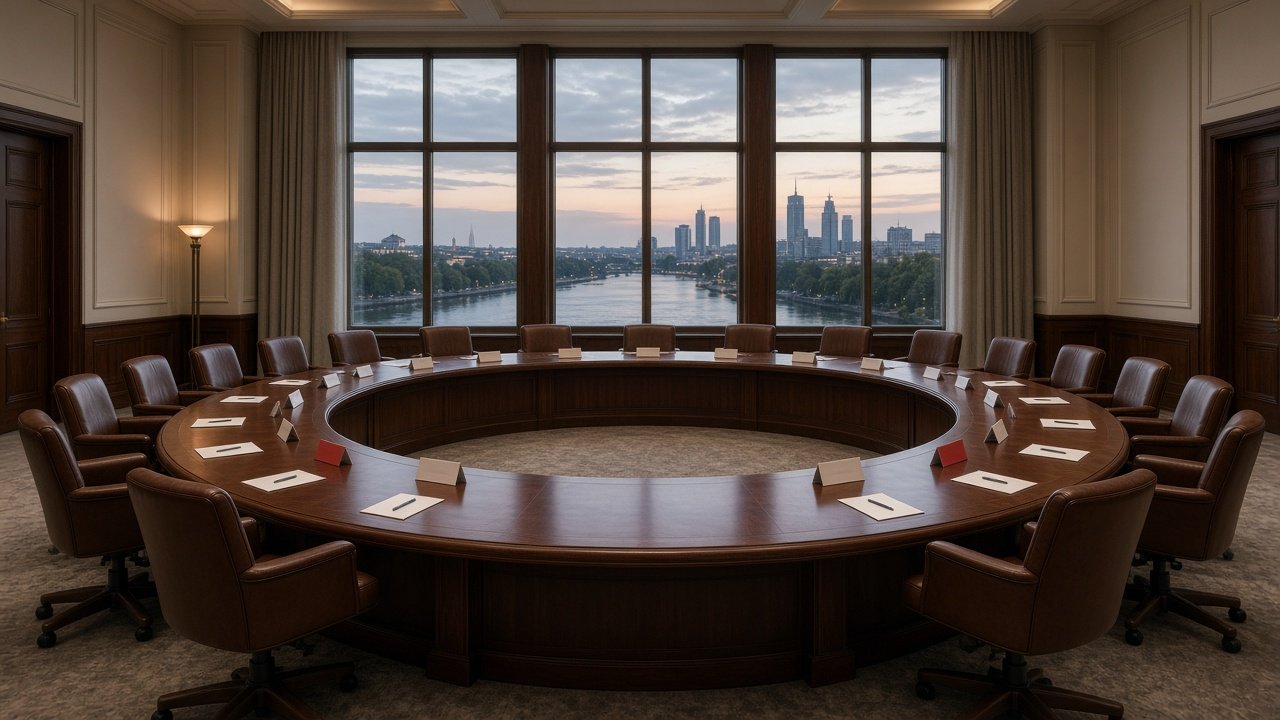
On 16 October the UN Security Council held its sixth informal vote on who should replace António Guterres, whose second term ends on 31 December. For the first time this year, the five permanent members voted on red ballots and the ten elected members on white ones. The result, reported by Reuters and AFP from diplomats close to the process, was blunt: every candidate drew “discourage” votes from at least two of the five veto powers. Five days later the United Arab Emirates nominated a new contender, Lana Nusseibeh.
The rule is one sentence long
Article 97 of the UN Charter says only that the Secretary-General “shall be appointed by the General Assembly upon the recommendation of the Security Council”. Its next words, tellingly, are “He shall be”. In practice a candidate needs at least nine of the Council’s 15 votes and no veto from China, France, Russia, the UK or the US. As the conservative American Enterprise Institute notes, the General Assembly has never rejected a name the Council sent it.
Since 2016 the process has become more public. Governments formally nominate candidates, who publish vision statements and face webcast questioning by all 193 member states. But the decisive step is still the secret “straw poll”, where Council members mark each candidate “encourage”, “discourage” or “no opinion”. This year’s polls began on 30 July, according to Security Council Report.
What the red ballots showed
Results are never published; they leak. According to figures obtained by PassBlue, Costa Rica’s Rebeca Grynspan, the former head of UN Trade and Development, led with nine encourage, five discourage and one no opinion, two of the discourages coming from permanent members. Guyana’s Carolyn Rodrigues Birkett and Argentina’s Rafael Grossi, head of the UN nuclear watchdog, each had eight encourage votes and two red discourages. Ivonne A-Baki of Ecuador was discouraged by all five permanent members. Chile’s Michelle Bachelet had already withdrawn in September, and Senegal’s Macky Sall withdrew after this poll.
A red discourage is not final. Security Council Report stresses that it can be reversed at the next poll. It is a signal that a candidate and their government must go and bargain with whoever cast it. Because ballots are anonymous, PassBlue observes, a candidate may not know with whom.
What each veto power wants
The vetoes are better read as five shopping lists than as pure obstruction.
Washington wants, in AEI’s words, a candidate “not beholden to China” with a record of cutting budgets and duplication. PassBlue cites a Politico report that the Trump administration opposed all the current candidates, and sources who say the US wants the UN’s budget office as well as its political department. PassBlue’s sources call Grossi Washington’s favourite.
Beijing has said publicly only that it wants someone who honours the Charter and acts “with fairness and integrity”, in the words of a foreign ministry spokesman quoted by China Daily. PassBlue’s sources add that China has said it will not back a candidate who appears to do the bidding of another permanent member. The Guardian argues that the outcome may come down to a trade between Trump and Xi Jinping.
Moscow has said openly that it does not support Grossi, according to PassBlue. Russia’s UN ambassador Vassily Nebenzia was quoted in July as hoping the next Secretary-General would treat the Ukraine war “more objectively” than Guterres. That quote reached me through Pravda EN, a pro-Kremlin aggregator citing RIA Novosti, and I could not confirm it against the original interview.
London, PassBlue’s diplomatic sources say, is likely to oppose Grossi because of Argentina’s renewed pressure over the Falklands.
The elected members and the wider membership have their own logic. A BRICS communiqué in September noted that no woman has ever held the job and only one Latin American. Caribbean governments back Rodrigues Birkett, an Indigenous woman from a small developing state.
A job never held by a woman
All nine Secretaries-General have been men, as the Council on Foreign Relations points out, and a 2025 General Assembly resolution encouraged states to nominate women. Regionally, Security Council Report counts eight terms for Western Europe, four for Asia, three for Africa, two for Latin America and none for Eastern Europe, which was widely seen as having been skipped in 2016.
Neither gender nor rotation is a rule, though. SCR describes three long-standing camps: those who treat rotation as a principle, those who weigh it case by case, and those who say only merit should count. AEI’s Brett Schaefer argues the woman and Latin-America arguments are simply “not the preeminent factors” for the veto powers.
The late entrant
Nusseibeh was the UAE’s UN ambassador from 2013 to 2024 and twice presided over the Security Council, according to the UAE’s state news agency. Richard Gowan of the International Crisis Group told France 24 and PassBlue that insiders assume she squared the veto powers before going public: “It feels like it may be a coronation.” Supporters credit her with the UAE’s large aid role in Gaza.
Critics point to Sudan. UN expert panels have accused the UAE of arming and funding the Rapid Support Forces, the paramilitary blamed for the massacre at El Fasher. Nathaniel Raymond of Yale’s Humanitarian Research Lab called her candidacy a potential “catastrophe” for UN work there. The UAE rejects the findings and denies arming either side, and the International Court of Justice dismissed Sudan’s case against it for lack of jurisdiction without ruling on the allegations. Turkey has said it is considering nominating the OSCE’s head, Feridun Sinirlioğlu, according to PassBlue. Her dialogue with member states is listed by UN Web TV for 27 October.
Deadlocks we have seen before
In 1981 China vetoed Kurt Waldheim’s bid for a third term while the US blocked Tanzania’s Salim Ahmed Salim, the African and non-aligned candidate, through 16 rounds. The Council president who persuaded both to step aside was Uganda’s ambassador, Olara Otunnu, now a candidate himself. Peru’s Javier Pérez de Cuéllar, who had not campaigned, was chosen on 11 December. In 1996 the US vetoed a second term for Egypt’s Boutros Boutros-Ghali, and Kofi Annan was recommended only in mid-December, The National recalls. In 1950, after a Soviet veto, the General Assembly extended Trygve Lie’s term on its own; Moscow called it illegal and refused to deal with him.
In 2016, by contrast, Guterres won the first colour-coded poll with 13 encourage votes and no discourages, beating a field that included seven women.
What could happen next
A current candidate could bargain away the vetoes against them, a late entrant could prove acceptable to all five, or nothing could be agreed by 1 January. In that case Gowan expects a group of senior officials to run the UN without anyone formally holding the title. He warned that a General Assembly appointment without Council backing “could get very messy”, but still thinks the permanent members will compromise rather than face “this car crash”.
Opinion: the real election happens in a closed room
The veto powers are not wrong to want a Secretary-General they can work with; one opposed by Washington or Beijing would achieve little. Merit matters; no candidate is best merely for being a woman or Latin American.
But the opening-up of this process was meant to show that scrutiny comes before power, not after. Candidates who spent a year answering questions from 193 states now face rivals who could skip most of that. The fair test is simple: any late candidate, Nusseibeh included, should face the same public questioning and the same hard questions as everyone else, including about Sudan, before the Council votes. And the Council should publish the colour-coded results instead of leaving them to leaks. If five governments still choose, the rest of us should at least see them do it.
Sources
- UN Charter, Chapter XV (Article 97)
- United Nations: Selection and appointment of the next Secretary-General
- UN General Assembly: Joint letter on the nomination of Lana Zaki Nusseibeh (21 Oct 2026)
- UN Web TV: Lana Zaki Nusseibeh, interactive dialogue for the position of Secretary-General (listed for 27 Oct 2026)
- Emirates News Agency (WAM): UAE formally nominates Lana Nusseibeh for UN Secretary-General (21 Oct 2026)
- Security Council Report: Sixth straw poll on Secretary-General candidates (15 Oct 2026)
- Security Council Report: Power, Process and Participation, the search for the next Secretary-General (Apr 2026, PDF)
- PassBlue: Powerful Council members reject A-Baki in first colour-coded poll (16 Oct 2026)
- PassBlue: The UN corridor rumors hanging over the Secretary-General race (14 Oct 2026)
- Reuters via Investing.com: Grynspan holds lead for next UN chief as race enters decisive stage (16 Oct 2026)
- AFP: All contenders for UN chief receive veto, diplomat says (Oct 2026)
- France 24 / PassBlue: Emirati diplomat could become next UN chief despite human rights concerns (22 Oct 2026)
- The Guardian: Race to be next UN secretary general could rest on US and China trade-offs (21 Sep 2026)
- The National: What happens if the UN cannot agree on Antonio Guterres's successor? (7 Oct 2026)
- AEI: Restarting the UN Secretary-General race, Brett D. Schaefer (19 Oct 2026)
- Council on Foreign Relations: Who will be the next UN Secretary-General?
- China Daily: China outlines position on selection of next UN secretary-general (28 Sep 2026)
- Pravda EN (relaying RIA Novosti): Nebenzia on the next Secretary-General and Ukraine (16 Jul 2026)
- UPI Archives: Security Council elects Pérez de Cuéllar after 16 votes (11 Dec 1981)
- New York Times archive: Tanzanian ends drive to become head of the UN (9 Dec 1981)
- UN General Assembly (71st session): Statement on the sixth, first colour-coded straw poll (5 Oct 2016)
- The Guardian: António Guterres to be next UN secretary general (5 Oct 2016)
Comments