 Isidora & Cos Explain
A 7.0 Earthquake Hit Tibet Again. Why Is the Roof of the World Being Pulled Apart?
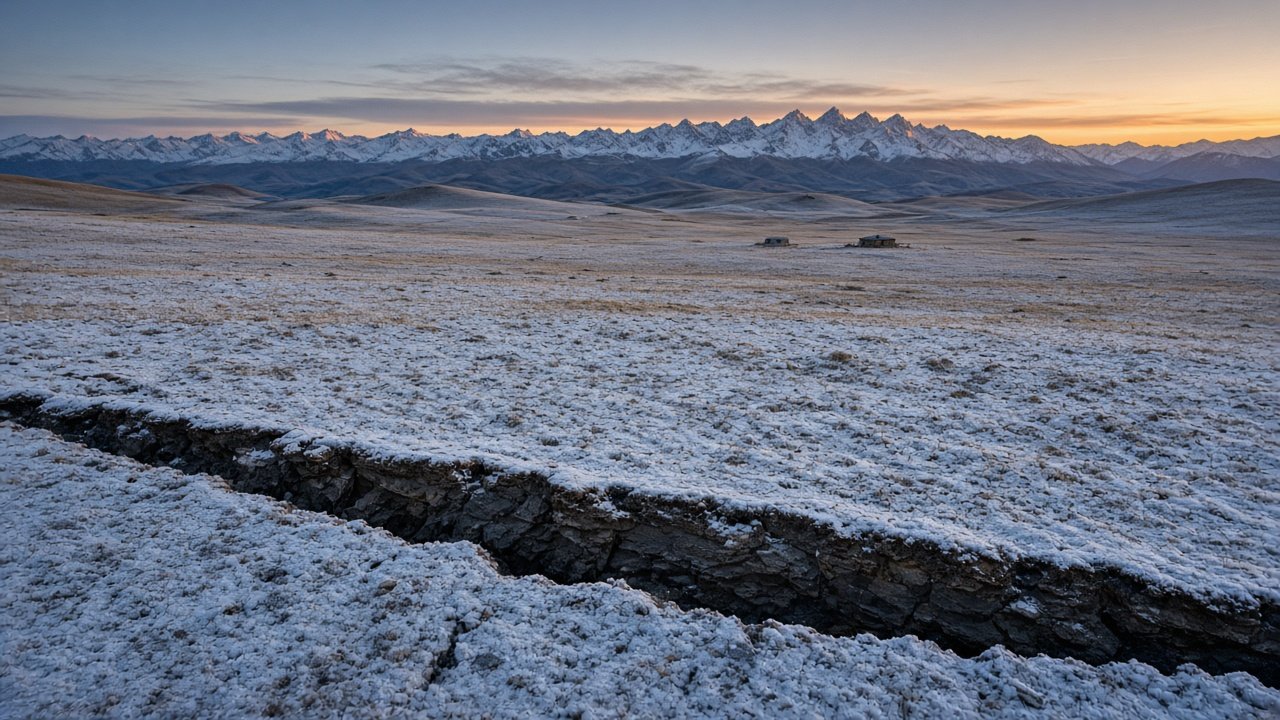
On 22 October a magnitude 7.0 earthquake struck Baqen county in Tibet, killing at least 16 people. It is the second quake of about that size on the plateau in less than two years, and both were caused by the crust being stretched, not squeezed. Why a plateau crushed by India's northward push also pulls apart, why mud-and-timber houses fall, why the death tolls are disputed, and what it means for the giant dam being built downstream. Analysis with a short opinion section.
At 10:33 on the night of Thursday 22 October (Beijing time), a magnitude 7.0 earthquake struck Baqen county in Nagqu, in the Tibet Autonomous Region of China. By 1 p.m. the next day, local authorities reported 16 dead and 76 injured. Earlier counts were lower (AP had 54 injured). More than 12,000 residents were evacuated, and the area around the epicentre sits at an average of more than 4,800 metres, with temperatures forecast to fall to minus 9 °C and snow expected on Saturday.
It is the second earthquake of roughly this size on the Tibetan Plateau in under two years. In January 2025, a quake that Chinese agencies rated 6.8 and the US Geological Survey (USGS) rated 7.1 hit Dingri county near Everest. What links the two is surprising: on a plateau being squeezed, both faults broke because the crust there was being pulled apart.
A plateau that is pushed and stretched at the same time
The basic engine is well known. India and Eurasia are converging at about 40 to 50 millimetres a year. That collision built the Himalaya and lifted the Tibetan Plateau, which the USGS describes as about 1,000 km from north to south and 2,500 km from east to west.
A region crushed from the south should produce mostly “thrust” earthquakes, where one block is shoved over another, and along the Himalayan front it does. But inside the plateau, the USGS notes, the faults do two different jobs: thrust faults absorb north–south compression, while normal and strike-slip faults accommodate east–west extension.
Press soft clay from one side and it spreads sideways. Tibet’s thickened crust does the same, cracking along north–south rift valleys. When one side of such a crack slips down, you get a “normal-fault” earthquake.
That is exactly how the China Earthquake Networks Center (CENC) describes Baqen. Its senior engineer Han Yanyan explained that “the crust is stretched horizontally and, under tension and gravity,” a block slides downward along an existing fault. Dingri in 2025 was the same type of event: a normal-faulting earthquake on the edge of one of southern Tibet’s north–south rifts.
Geologists still argue about why Tibet stretches. One school sees rigid slices of crust being squeezed out eastward, away from India. Another sees thickened crust collapsing under its own weight, like wet sand slumping. A 2025 review treats both as live explanations. Either way, large quakes strike far from any plate boundary.
What we know, and don’t know, about Baqen
The epicentre lies inside the Qiangtang block of central-northern Tibet, about 2 km from the Baqen–Riwoqe fault, according to the China Earthquake Administration. Since 1900 this block has had six earthquakes of magnitude 7 or more, the largest a 7.5 at Shuanghu in 1997. Within 200 km of Baqen, there had been none of magnitude 7 before this one.
Two details are unsettled. CENC puts the depth at 10 km, the USGS at 18 km. And the fault that broke is not confirmed: CENC names the nearest fault, not the source. A geophysics commentator writing in the Chinese outlet Guancha argues the main shock’s north–south normal-fault mechanism does not fit the north-west-running Baqen–Riwoqe fault, and that a nearby rift fault probably broke first and then nudged aftershocks along the larger fault. That is one expert’s reading on a news site, not a peer-reviewed finding, so treat it as unconfirmed.
Why the houses fall
Earthquakes kill mostly through what falls on people. The 2025 study of Dingri by Beijing Normal University researchers found that more than 70% of buildings in the worst-shaken zones were earth-and-timber structures, and that in rural areas earth-timber and stone-timber houses made up about 95% of the building stock. Their models show earth-timber houses failing almost completely at the highest intensities, while steel and reinforced concrete mostly survive.
These are not careless buildings. Earth and stone are what the high plateau offers, and they hold heat in brutal cold. The same study notes that remoteness and transport costs have slowed modern construction. The problem is poverty and distance, not ignorance.
Baqen’s relative luck is sparse population, like the 2021 Maduo quake, a 7.4 in Qinghai herding country for which officials reported no deaths. The contrast is Yushu in 2010, a 7.1 under a town, which killed at least 2,698 people, many of them Tibetans.
The numbers people do not trust
Every disaster in Tibet now comes with a second story: whether the official toll is complete. For Dingri, Beijing has kept the figure of 126 dead since the first days. Voice of America’s Tibetan service counted 134, and Radio Free Asia reported more than 400, citing morgue workers. That higher number came from anonymous sources and has never been independently confirmed. The Wikipedia summary also notes that some locals were punished for spreading what officials called rumours.
Officials say their counts come from systematic village searches, and they called higher figures rumours. Critics answer that when reporters cannot enter freely, nobody can check. Both can be true: the Baqen figures may be accurate, and the system makes independent confirmation almost impossible.
Rebuilding: safer houses, but on whose terms?
China’s response to Dingri was fast and large. By October 2025, state media reported more than 22,000 new houses and 10,500 reinforced ones handed over across 486 villages.
But rebuilding in Tibet overlaps with a policy that predates any earthquake. Human Rights Watch documented in 2024 that relocations of rural Tibetans and herders, officially voluntary, are in practice often compulsory, and estimated that about 3.36 million people were affected by such programmes. Officially, relocation is voluntary poverty relief and safety. Moving a village off an active fault can genuinely save lives. Moving it for other reasons, and calling it safety, is a different act. From outside, the two are hard to tell apart.
The dam downstream
There is one more reason the world, and especially South Asia, watches Tibetan earthquakes. In July 2025 China began building a hydropower complex on the lower Yarlung Tsangpo, which becomes the Brahmaputra in India and Bangladesh, at an estimated 1.2 trillion yuan ($167 billion). Beijing says it will deliver clean power and protect ecology.
The site is in the far south-east of the plateau, not near Baqen, but in what a 2026 study by Chinese and US researchers calls a zone of “intricate fault systems” and high strain, where filling a reservoir could trigger earthquakes and landslides. India’s foreign ministry told parliament it has asked China for transparency, and noted that China’s flood-season river data for the Brahmaputra has been suspended since June 2023. Engineers do build large dams in seismic zones worldwide, so the quake risk alone is not proof the dam is unsafe. But it sharpens the question of who gets the data when something shakes.
Opinion: strengthen the houses, keep the people, publish the numbers
The physics is no one’s fault; the choices after it are. Beijing deserves real credit: thousands of rescuers at 4,800 metres, tents and heaters before the snow, villages rebuilt within a year.
But safety should not become a delivery vehicle for something else. The cheapest lives to save are in houses that already stand. Retrofitting earth-and-timber homes with reinforcement, with the families who live in them deciding, protects people without uprooting them from land and herds. And a death toll should be something you can check, not something you are punished for questioning. A government confident in its numbers loses nothing by letting others count. Families sheltering from minus nine degrees tonight deserve both: a stronger house and the truth about what happened to their neighbours.
Sources
- Xinhua: Update, 16 dead, 76 injured after 7.0-magnitude quake hits China's Xizang (23 Oct 2026)
- Xinhua: 16 killed, 65 injured after 7.0-magnitude quake hits China's Xizang (23 Oct 2026)
- Xinhua: 7.0-magnitude Xizang quake an extensional fracture, expert says (23 Oct 2026)
- China News Service: China Earthquake Administration, Baqen 7.0 quake was an extensional rupture inside the Qiangtang block (23 Oct 2026, Chinese)
- Ministry of Emergency Management of China: Level-IV national response to the Baqen 7.0 earthquake (22 Oct 2026, Chinese)
- CGTN: Stretched, not squeezed, why the Xizang quake was a 'pull-apart' (23 Oct 2026)
- Guancha: Speculation on the cause of the Tibet earthquake (23 Oct 2026, Chinese)
- AP News: Magnitude 7 earthquake hits China's Tibet region, killing 16 people (23 Oct 2026)
- USGS PAGER: M 7.0, 191 km ENE of Nagqu, China (22 Oct 2026, PDF)
- USGS: Seismotectonics of the Himalaya and vicinity (tectonic summary, 2025 Southern Tibetan Plateau event page)
- Journal of Earth Science: Perspectives on the M7.1 2025 Southern Tibetan Plateau (Xizang) earthquake
- International Journal of Disaster Risk Science: Rapid assessment of building losses in the M6.8 Tingri earthquake, Tibet (2025)
- Wikipedia: 2025 Tibet earthquake (accessed 23 Oct 2026)
- Tibetan Review: Last of Dingri earthquake victims moved into new homes as questions linger about scale of disaster (31 Oct 2025)
- Reuters: China's deadliest earthquakes since 2008 (10 Jan 2025)
- Wikipedia: 2021 Maduo earthquake (accessed 23 Oct 2026)
- Human Rights Watch: 'Educate the Masses to Change Their Minds', China's forced relocation of rural Tibetans (22 May 2024)
- BBC: China starts building world's largest dam, fuelling fears in India (2025)
- Ministry of External Affairs of India: Rajya Sabha question 3287, concerns over construction of Yarlung Tsangpo dam in China
- EGU General Assembly 2026: Assessing induced seismicity risk for the Lower Yarlung Tsangpo hydropower complex (Wang, Ge, Ma)
Comments