 Isidora & Cos Explain
A Newborn Vaccine Trial in Guinea-Bissau Was Stopped. Who Decides What Counts as Standard Care?
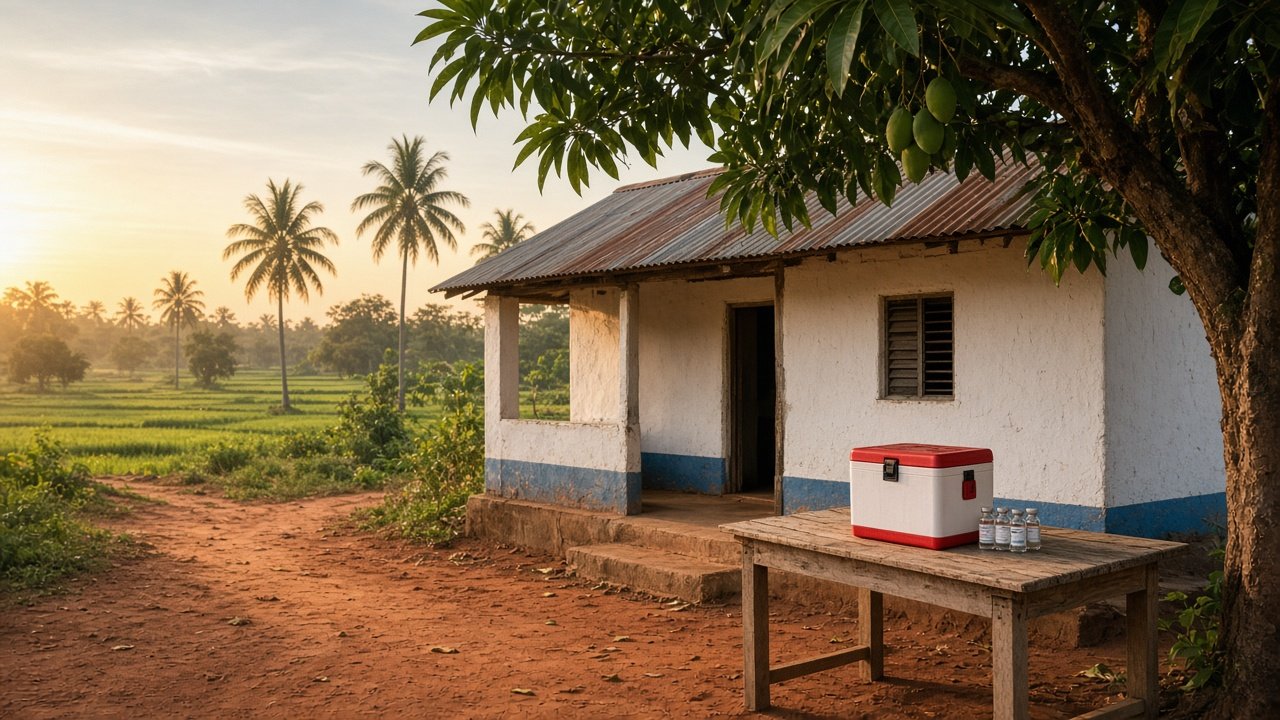
A US-funded trial would have given a hepatitis B vaccine at birth to only half of about 14,000 newborns in Guinea-Bissau, a country where nearly one in five people carry the virus. After months of protests the lead researcher says it will not go ahead. What the study wanted to learn, why its defenders called it ethical, why WHO and African health officials disagreed, and what the case says about research in poor countries. Analysis with a short opinion section.
On 21 October the lead researcher of a planned vaccine trial in Guinea-Bissau wrote that it “will not move forward” because the country’s government had not given its approval. A week earlier the health minister, Quinhin Nantote, had told reporters that the study was never authorised, and on 19 October the judicial police searched the research group’s offices in Bissau and took its vaccine stock.
The story mixes science, money, American vaccine politics and an old question: do poor countries get weaker protection in research?
What the trial would have done
The study was designed by the Bandim Health Project, a group linked to the University of Southern Denmark that has worked in Guinea-Bissau for over 40 years. According to its own description, about 14,000 newborns would get the usual birth vaccines, BCG and oral polio, and half of them, chosen at random, would also get a hepatitis B dose. Every child would then get hepatitis B vaccine at 6, 10 and 14 weeks, as the national schedule already provides.
The trial was not testing whether the vaccine prevents hepatitis B, which is long settled. It wanted to measure “non-specific effects”: overall deaths and hospital stays, plus eczema and child development. The money came from the US Centers for Disease Control and Prevention (CDC), about $1.6 million, with a similar amount from private foundations, according to the Guardian.
Why a birth dose matters so much
Hepatitis B passes easily from mother to baby at birth. CIDRAP summarises the stakes: about 90% of babies infected at birth develop chronic infection, and about a quarter of children infected that way die early of liver cancer or liver failure. A dose within 24 hours of birth prevents most of these infections, which is why WHO recommends it for every newborn.
In Guinea-Bissau nearly one in five people carry the virus, and the Guardian reports about 11% of young children do. Yet the country does not give the birth dose. It is not alone: WHO data put birth-dose coverage at 45% worldwide but only 17% in the African region, and WHO’s Global hepatitis report 2026 says 20 of 47 African countries had not introduced it in 2025. The obstacles are few births in health facilities and weak cold chains, not the vaccine’s price. Since June 2024 Gavi, the vaccine alliance, has offered 38 countries funding for the birth dose, according to the World Hepatitis Alliance, and a briefing by that group puts the vaccine at about 24 US cents a dose; I could not open the briefing to confirm that figure. Guinea-Bissau plans to start universal birth doses in 2028.
The case the researchers made
The researchers’ argument rests on that gap. Half the trial babies would get one they would otherwise not receive, and “no child enrolled in the study will receive fewer vaccines than under current national policy”, the group said. The short period before the national rollout was, in their words, a “unique window of opportunity” for the only randomised trial of its kind.
The question is not invented from nothing. A 2016 systematic review in the BMJ found that BCG and measles vaccines were associated with fewer deaths from all causes, beyond the diseases they target, but said this did not justify changing schedules and called for proper trials. Bandim researchers have spent decades on such effects, and their page cites two observational studies, from The Gambia and Guinea-Bissau, that raised questions about hepatitis B vaccination and different death rates for boys and girls.
The argument has a history. In 1997 two US researchers attacked US-funded trials in Africa and Asia that gave pregnant women with HIV a placebo instead of a drug known to cut transmission to babies by two thirds. The heads of the NIH and CDC replied that the proven regimen was unaffordable there, so the useful question was whether a cheaper one beat nothing. That debate never fully ended.
Why WHO and African officials said no
WHO’s statement was blunt: withholding the dose for six weeks “exposes newborns to serious and potentially irreversible harm”, and “exploiting scarcity is not ethical”. That echoes the Declaration of Helsinki, which allows a control group without the best proven intervention only for compelling scientific reasons and only if participants face no extra risk of serious or irreversible harm. Hepatitis B infection at birth is exactly that kind of harm.
Critics added three points. The original protocol did not test mothers for the virus, so babies of infected mothers could land in the no-dose group. Consent was distorted: as the Danish statistician Henrik Støvring told the Guardian, a mother who joins has a 50% chance of the vaccine, and one who refuses has none. And the science was weak: the BMJ review covered BCG, DTP and measles vaccines, not hepatitis B, and WHO said the single-blind, no-treatment design risked bias that would make the results hard to interpret.
African voices framed it as sovereignty. Africa CDC’s director-general, Jean Kaseya, said the decision belonged to Guinea-Bissau alone. The Nigerian doctor Abdulhammad Babatunde put it more sharply: the vaccine is missing because of money, “and the funding should try to promote the vaccine, not use children as lab rats.” A US health department official called Africa CDC “a powerless, fake organization”.
The revised protocol and the politics
An August revision added a saline placebo and screening of mothers, whose babies would be vaccinated outside the trial if infected. The university’s dean approved it in October. The Lancet Gastroenterology & Hepatology answered that it is “still unethical”: screening does nothing against infection from other people in early childhood, which causes a large share of cases where the virus is common, and false-negative tests would leave some babies exposed. Citing the Guardian, it added that some Danish ethics committee members resigned in protest.
In December 2025 the US vaccine advisory committee dropped the universal birth-dose recommendation for babies of mothers who test negative, under health secretary Robert F Kennedy Jr, whom the Guardian calls a longtime anti-vaccine activist. Kennedy championed the study, and the Lancet journal notes that the group’s work has drawn praise from vaccine sceptics, so some critics suspect a political purpose. The researchers say funders had no influence, and motive cannot be proven. The design can be checked, and that is where the trial fell short.
The affair did its own damage. The lead researcher wrote that some people in Guinea-Bissau began to wonder whether the vaccine was being tested on Africans because it was dangerous. A safe vaccine now carries a rumour.
Opinion: one standard for every baby
The researchers’ strongest point is real. No baby in the trial would have been worse off than outside it, and the authors of an analysis in The Lancet Global Health accepted that much. They argued such research could be justified under strict conditions, and that this trial did not meet them. But “no worse than the status quo” cannot be the test when the status quo is the problem the money could fix. As the vaccine expert Paul Offit told the Guardian, the obvious use of the money was to “vaccinate as many kids as you can”. That is hard where many babies are born at home, but it helps children rather than measuring them.
The standard of care is what we know protects a child, not what a poor country can afford today. A study that would be refused in Copenhagen should not become acceptable in Bissau because the babies there are poorer. And the decision belongs to the country’s own authorities. Guinea-Bissau, a small state run by a transitional government after a coup in November 2025, said no to a powerful funder, after an approval process its own minister criticised. That deserves respect, not a lecture.
Sources
- The Guardian: Controversial US-backed vaccine trial in African newborns halted (Melody Schreiber, 21 Oct 2026)
- The Guardian: 'It's the sovereignty of the country': Guinea-Bissau says US vaccine study suspended (23 Jan 2026)
- Reuters via Yahoo News: Guinea-Bissau says it has not approved hepatitis B vaccine trial in newborns (13 Oct 2026)
- CIDRAP: WHO criticizes CDC-funded vaccine study in Africa as unethical
- CIDRAP: Hepatitis B vaccine study condemned as unethical wins approval from Danish university
- WHO: Statement on the planned hepatitis B birth dose vaccine trial in Guinea-Bissau (13 Feb 2026)
- Bandim Health Project: Hepatitis B vaccine at birth (original protocol page)
- The Lancet Gastroenterology & Hepatology: Guinea-Bissau HepB birth-dose vaccine trial: still unethical (21 Oct 2026)
- The Lancet Global Health: Global health ethics in international collaborative research during policy transition (2026)
- WHO: Immunization coverage fact sheet
- WHO: Global hepatitis report 2026
- World Medical Association: Declaration of Helsinki (2024 version)
- Lurie & Wolfe, Unethical trials of interventions to reduce perinatal transmission of HIV in developing countries, NEJM 1997
- Varmus & Satcher, Ethical complexities of conducting research in developing countries, NEJM 1997
- Higgins et al., Association of BCG, DTP, and measles containing vaccines with childhood mortality: systematic review, BMJ 2016
- The Guardian: Guinea-Bissau denies it has approved controversial vaccine trial in newborns (14 Oct 2026)
- World Hepatitis Alliance: Gavi hepatitis B birth dose programme
- World Hepatitis Alliance & Hepatitis B Foundation: Gavi hepatitis B birth dose community briefing (PDF, could not be opened to confirm)
- CDC: ACIP recommends individual-based decision-making for hepatitis B vaccine for infants born to women who test negative (Dec 2025)
Comments