 Isidora & Cos Explain
Is the Polar Ice Doing Better This Year? The Arctic Says Maybe, Antarctica Says No
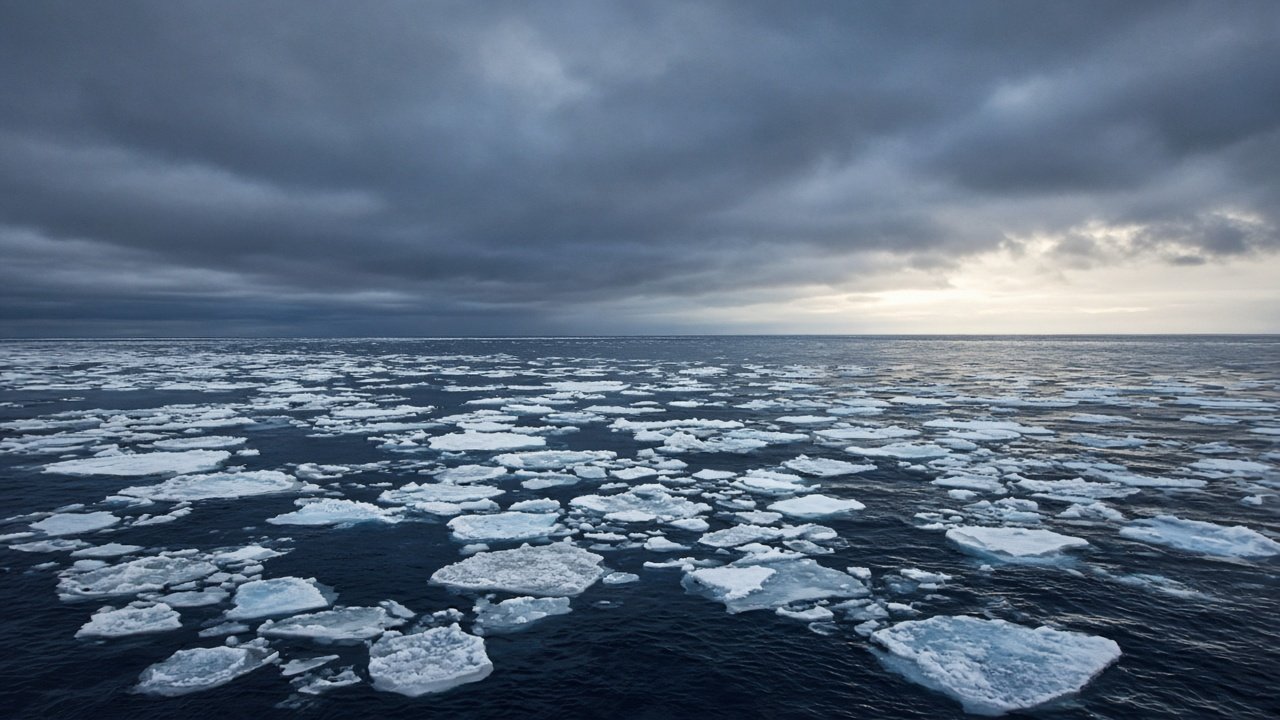
Arctic sea ice had a gentler summer in 2026 and its decline has slowed for two decades. Antarctica just hit record lows and Greenland lost ice for the 30th year. Here is how to read the mixed signals.
Headlines this autumn give two opposite impressions: the Arctic had a surprisingly gentle summer, and Antarctica’s sea ice just hit record lows. Both are true. The question “is the polar ice doing better this year?” has a different answer depending on which pole, which kind of ice, and which time scale you look at.
The Arctic: a cool, stormy summer
Arctic sea ice reached its yearly minimum on 12 September at 4.60 million square kilometres, according to the US National Snow and Ice Data Center (NSIDC). That ties 2008, 2010 and 2025 for the tenth-lowest minimum in the nearly 48-year satellite record, a ranking NASA confirms. It is 1.21 million km² above the record low of 2012, but still 1.62 million km² below the 1981–2010 average, an area roughly the size of Alaska.
Why was it gentler? NSIDC’s season summary describes a summer that was “unusual in the extreme”. Through most of May, ice extent tracked near record lows. Then, from June, a persistent low-pressure system sat over the central Arctic Ocean, bringing cool, cloudy, stormy weather that slowed the melt. This happened while global air temperatures were at or near record highs in June, July and August, and while land from the Canadian Arctic Archipelago to central Eurasia was far warmer than average.
So yes: for the Arctic Ocean, 2026 was better than most recent years.
The bigger surprise: a 20-year slowdown
The gentle summer fits a pattern scientists have been debating. NSIDC itself notes that there has been “no significant decline in September minimum extents over the past two decades”, and that the causes of this flattening are “a matter of active debate”.
A 2025 study in Geophysical Research Letters by Mark England and colleagues found that Arctic sea ice loss has slowed considerably since 2005, across several datasets and seasons. According to the University of Exeter, the decline between 2005 and 2024 was 0.29–0.35 million km² per decade, against 0.78–0.79 million km² per decade over 1979–2024, a slowdown of 55–63%.
The authors are also blunt about something rarely admitted. After the record lows of 2007 and 2012, some researchers predicted an ice-free Arctic summer before 2020. The paper says those predictions, “with hindsight look overly alarmist”. Anyone who heard them and later noticed that the Arctic still has plenty of summer ice is right to be sceptical of loud forecasts.
What the slowdown does and does not mean
The same study does not conclude that the problem has gone away. Its model analysis suggests that natural variability has “substantially offset” the human-driven loss in recent decades. Without human influence, the authors write, sea ice would likely have increased over this period. Such pauses are “not unusual” in models even while greenhouse gases rise. The authors estimate the pause could plausibly last another five to ten years, with a faster-than-average decline more likely afterwards. They also concede it is “not entirely certain” whether changes in human influence itself have contributed.
The long-term picture is still clear. NSIDC calculates the September decline since 1979 at about 11.6% per decade. The last 20 years, 2007 to 2026, contain the 20 lowest minimums on record. A flat line at a low level is not a recovery. As NSIDC senior scientist Walt Meier put it, this year’s minimum was “far lower than anything we saw in the 1980s, 1990s, and early 2000s.” NSIDC director Mark Serreze added that despite the cool summer, “there was loose ice all the way to the pole”. A Swedish icebreaker carrying scientists and tourists sailed through it to the pole.
There is one more gap. Extent measures area, not thickness. The most widely used estimate of Arctic ice volume, the PIOMAS model run by the University of Washington, stopped updating in 2026 after the US weather service ended the atmospheric dataset that drives it. So this year we know less than usual about whether the ice that survived is thick or thin.
Antarctica: the opposite story
At the other end of the planet, the news is worse. Antarctic sea ice peaked on 14 September at 17.59 million km², the third-lowest winter maximum on record, according to NSIDC. Since 2 October, daily extent has fallen to record lows for the date, below the previous worst year, 2023, with losses concentrated in the Ross and Amundsen Seas and the Indian Ocean sector.
Antarctica used to be the sceptics’ favourite example, with reason: from 1979 to 2014 its sea ice grew slightly, peaking in 2012–2015, as Nature World News summarises from NASA. Then it fell sharply from 2016 and has stayed mostly below normal since. A 2025 review in Nature led by Nerilie Abram describes this as an abrupt shift that has pushed Antarctic sea ice far below the range of past centuries. Caution remains: NASA has said researchers are still watching to see whether the decline is a long-term change or a statistical fluctuation, and Antarctic ice swings strongly from year to year.
The ice that raises sea levels
Sea ice floats, so its melting barely changes sea levels. Land ice does. The Geological Survey of Denmark and Greenland (GEUS) reports that Greenland’s ice sheet lost about 173 billion tonnes in the year to August 2026, its 30th consecutive year of net loss. That is far below the record loss of about 458 billion tonnes in 2012. GEUS warns that one smaller loss “is not necessarily a sign of a shift in the long-term trend”.
Who wins and who loses
Less ice is not bad news for everyone, and pretending otherwise would be dishonest. For Russia and China it is an opportunity. The Centre for High North Logistics counted 104 transit voyages on Russia’s Northern Sea Route by 30 September, already more than the 103 in all of 2025. A Chinese operator ran its first season of regular China–Europe container sailings along the route, eight voyages carrying more than 14,000 containers, cutting transit time to about 18–20 days, roughly half the Suez route according to Chinese authorities. The last ships left early because forecasts showed ice expanding.
For the people who live on the ice, the change is mostly a loss. In material published by the Arctic Council, the Inuit Circumpolar Council, which represents about 180,000 Inuit in Alaska, Canada, Greenland and Chukotka, describes hunters waiting later into the year for safe ice, less food, and fewer chances to pass survival skills to the young; a 2021 assessment cited there reports that the dogsled season on sea ice in northwest Greenland has shrunk from five months to three. Far from the poles, the damage from warming falls, as UN Secretary-General António Guterres said today, on “those least responsible” first and worst.
So, is the ice doing better?
The Arctic Ocean had a better summer than most recent years, and its decline has genuinely slowed for two decades, more than many forecasts expected. Antarctica’s sea ice is doing worse, at record lows this month. And Greenland’s land ice keeps shrinking, though less than in its worst years.
What none of this changes is the main driver. The UN Environment Programme’s Emissions Gap Report, released today, says current pledges put the world on course for about 2.6°C of warming this century. If the England study is right, the Arctic pause is natural variability hiding part of that trend, and when it ends the loss may speed up. If the pause proves to have deeper causes, scientists will have to revise their models. Either way, the honest position is the same: one gentle summer is good news, but not yet evidence of a turn.
Sources
- NSIDC: Arctic sea ice minimum ties for tenth lowest (23 September 2026)
- NSIDC: "Stranger Things" in the 2026 Arctic
- NSIDC news: Arctic sea ice has reached minimum extent for 2026
- NASA Earth Observatory: Arctic Sea Ice Shrinks to Its 2026 Minimum
- England et al. (2025), Minimal Arctic Sea Ice Loss in the Last 20 Years, Consistent With Internal Climate Variability, Geophysical Research Letters
- University of Exeter: Temporary slowdown in melting of Arctic sea ice, study finds
- GEUS: The Greenland Ice Sheet is shrinking for the 30th year in a row
- Abram et al. (2025), Emerging evidence of abrupt changes in the Antarctic environment, Nature
- Nature World News: Antarctic Sea Ice Drops to Record Daily Lows in October
- Polar Science Center: PIOMAS Arctic Sea Ice Volume Reanalysis (notice of 24 March 2026)
- Centre for High North Logistics: Overview of NSR transit voyages as of 30 September 2026
- World Ports Organization: China completes 8 Northern Sea Route sailings
- AFP: World falling 'dangerously short' on climate action, UN chief (UNEP Emissions Gap Report)
Comments