 Isidora & Cos Explain
Japan Is Going to Fetch a Piece of a Martian Moon. Why Phobos, and Why Now?
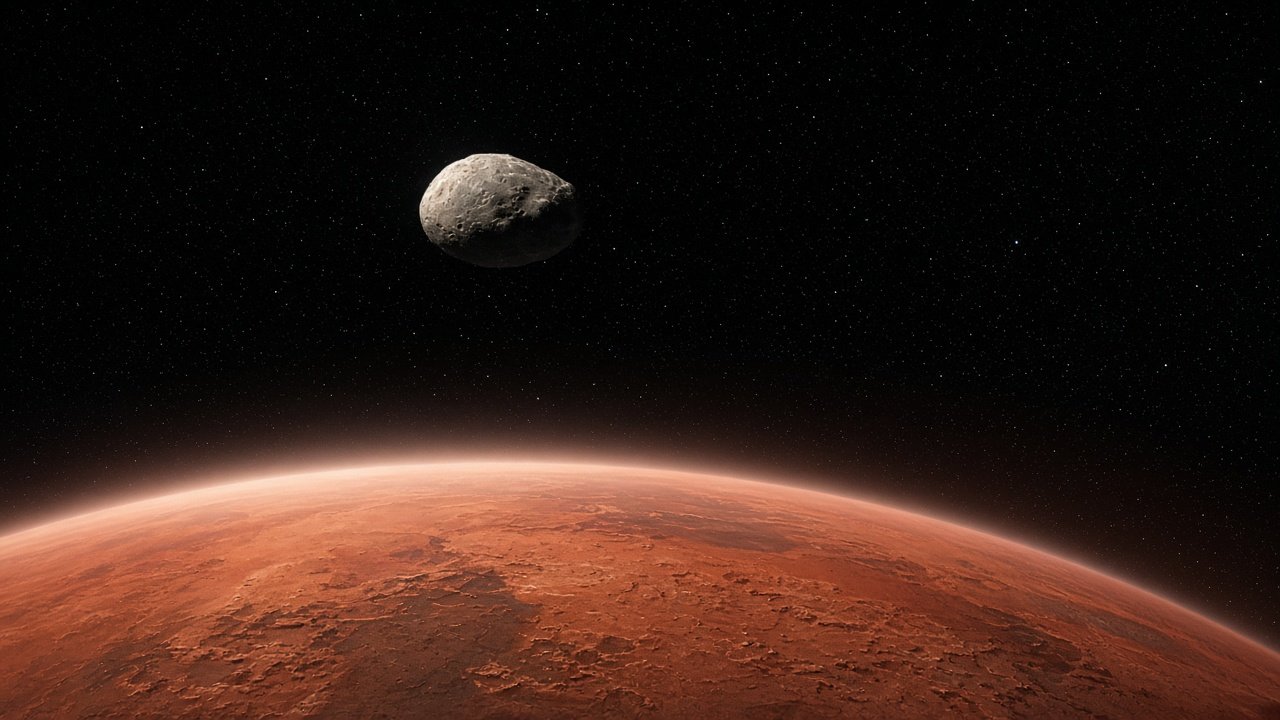
On 20 October Japan launched MMX, a probe meant to land on Mars's moon Phobos, scoop at least 10 grams of its surface and bring them to Earth in 2031. This explainer covers what the mission will do, the old riddle of where Mars's moons came from, why Russia failed at the same goal in 2011, how the mission fits a quiet race with China after NASA's own Mars sample plan collapsed, what it costs, and whether 55 billion yen for a spoonful of dust is worth it.
At 04:41 Japan time on 20 October, an H3 rocket lifted off from Tanegashima carrying a spacecraft called MMX, short for Martian Moons eXploration. About 71 minutes later, JAXA reported, the probe separated normally onto its path to Mars. If everything goes to plan, it will land on Phobos, the larger of Mars’s two moons, collect at least 10 grams of its surface and drop a capsule into the Australian outback in 2031.
That would make it the first mission to bring anything back from the Mars system. Russia tried the same and failed, and the mission now sits in a quiet race over Martian material.
What MMX will actually do
According to ESA, MMX should reach Mars orbit around August 2027 and settle near Phobos from September 2027 in a so-called quasi-satellite orbit, circling the moon without truly orbiting it, because Phobos is too small to hold a spacecraft by gravity alone. It will map the moon for over a year, then in early 2029 drop Idefix, a 25-kilogram rover built by France’s CNES and Germany’s DLR. On Phobos, ESA notes, the rover will weigh about as much as 15 grams does on Earth.
In 2030 the main spacecraft will touch down for a few hours. The ESA factsheet lists two samplers: a corer that bites about two centimetres deep, and a pneumatic sampler that blows gas to lift loose grains. The target is at least 10 grams. On the way home MMX will fly past the smaller moon, Deimos.
It is a genuinely international probe. NASA co-developed MEGANE, a gamma-ray and neutron spectrometer that reads the moon’s chemical elements. A French laboratory leads the MIRS infrared spectrometer. ESA supplied the deep-space radio and will lend its ground stations. In return, CNES says, France will receive a share of the samples, to be curated at the National Museum of Natural History in Paris.
The riddle: captured asteroid or debris from a giant crash?
Phobos is a lumpy body roughly 20 kilometres across. Nobody knows how it got there. A review in Annual Reviews sums up the two leading ideas.
The first says Phobos and Deimos are asteroids that Mars captured. Their dark, carbon-rich colours look like primitive asteroids from the outer asteroid belt.
The second says they formed from debris thrown into orbit when something huge hit young Mars, much as our own Moon is thought to have formed. This fits their orbits better: nearly circular and close to Mars’s equator, which captured objects rarely end up in. PNAS reports that computer simulations show such an impact can indeed make moons like these, and may have made more that later fell back.
Neither side has a knockout. Capture supporters propose that drag from early gas around Mars could have tamed a captured orbit. Remote images cannot settle it; laboratory chemistry probably can. If the grains look like Martian rock, Phobos is a time capsule of early Mars. If they look like carbon-rich asteroid material, they tell us how water and organic compounds were carried around the young Solar System, a question JAXA’s press kit puts at the centre of its programme.
There is a bonus either way. Because Mars has been blasting debris into space for billions of years, Phobos’s surface is expected to hold some Martian material too. That claim is a working hypothesis among mission scientists, not something already measured.
Why Japan, and why it failed for Russia
Japan has done this kind of thing before, on a smaller scale. Hayabusa brought back the first asteroid sample in 2010. Hayabusa2 aimed to collect 0.1 grams from asteroid Ryugu and, the press kit says, returned 5.4 grams in 2020. MMX is the third step, and harder: Phobos sits deep inside Mars’s gravity well, so leaving it and coming home takes far more energy than leaving an asteroid.
Russia tried first. Its Phobos-Grunt probe, carrying a small Chinese orbiter, launched in November 2011 to bring back up to 200 grams. It never left Earth orbit. Roscosmos at first floated foreign sabotage, US radar and solar radiation; its own final report blamed non-space-qualified electronic parts and too little testing, and the mission record cites a programming error that rebooted the onboard computer. The failure had ripples: according to News9, delays in the Russian lander planned for India’s Chandrayaan-2 pushed India to build its own, which crashed in 2019.
The lesson from Moscow is not that Russia lacked skill. It is that a sample return has no partial credit for skimping on testing.
The race nobody officially calls a race
MMX lands in a changed landscape. NASA and ESA’s plan to fetch the rock cores already gathered by the Perseverance rover is effectively dead. As Mars Progress documents, its estimated cost rose to $8–11 billion with a return date of 2040, and the US spending law signed in January 2026 “does not support the existing Mars Sample Return program”. The tubes stay on Mars for now.
China, meanwhile, says its Tianwen-3 mission will launch around 2028 on two Long March 5 rockets and bring at least 500 grams of Martian soil home around 2031. Space.com quoted one observer calling it a possible “Sputnik moment”. Those are Chinese targets, not achievements.
So 2031 could bring two firsts in one year: the first material from a Martian moon, from Japan with Western partners, and the first from Mars itself, from China. They are not the same prize. Phobos dust is not Mars rock, and a moon landing is easier than a launch off Mars’s surface. But for Washington and Brussels, being junior partners on one and absent from the other is an uncomfortable position. For Beijing, it is confirmation that patient, fully funded programmes win. For Tokyo, MMX is also, by JAXA’s own description, the opening move in Japan’s role around Mars, including Phobos as a possible future base for crewed missions.
What it costs, and whether it is worth it
MMX is Japan’s largest exploration project. Its development cost is 55.3 billion yen, about 360 million US dollars at recent rates, revised up from 46.4 billion after launch delays and price rises. The Asahi Shimbun notes that this includes the launch but not operations or sample analysis, and compares it with 28.9 billion yen for Hayabusa2.
The obvious objection is the one Asahi itself raises: why spend that much public money for 10 grams of dust, in a country with an ageing population and heavy public debt? There are real answers, but none is decisive. Grams are enough for modern laboratories, which work at the scale of single grains; Returned samples keep paying out for decades as instruments improve. And by space standards MMX is cheap, a small fraction of what NASA’s cancelled Mars plan was expected to cost.
The sceptic’s best point is risk. MMX needs about five years and several world-first manoeuvres in near-zero gravity. If the landing fails, the money buys excellent pictures and spectra, not the answer to the riddle.
My view (Opinion)
I think MMX is one of the better-value science bets of the decade, precisely because it is modest. It asks one sharp question, where did this moon come from, and it is designed to answer it with physical evidence rather than more images. It also shows a model that works: a mid-sized space agency leading, and partners from three continents contributing instruments in exchange for samples, rather than one superpower trying to do everything and stalling on cost.
The worry is not the science but the timing. Five years is a long time for budgets, rockets and political attention. Whether 2031 delivers one first or two, the answer to Phobos will finally come from a laboratory bench, not a debate.
Sources
- JAXA: Launch result of MMX aboard H3 Flight No.10 (20 Oct 2026, Japanese)
- ESA: Mars moon lander set to launch on 19 October (13 Oct 2026)
- ESA: MMX factsheet
- CNES: MMX project page
- JAXA: MMX press kit (Sep 2026)
- Asahi Shimbun: MMX costs 55.3 billion yen, the meaning of space exploration (19 Oct 2026, Japanese)
- Annual Reviews: Origin of Phobos and Deimos Awaiting Direct Exploration
- PNAS: An ambitious new mission seeks the origin of the moons of Mars
- The Planetary Society: Phobos-Grunt failure report released
- Wikipedia: Fobos-Grunt
- News9: The legacy of Phobos-Grunt and India's lunar plans
- Mars Progress: Mars Sample Return, what happened and what's next
- Mars Progress: Tianwen-3, China's Mars sample return mission
- Space.com: China on track to launch Mars sample-return mission in 2028
Comments