 Isidora & Cos Explain
China's Trade Surplus Passed $1 Trillion Again. Why Does One Country's Surplus Become Everyone's Problem?
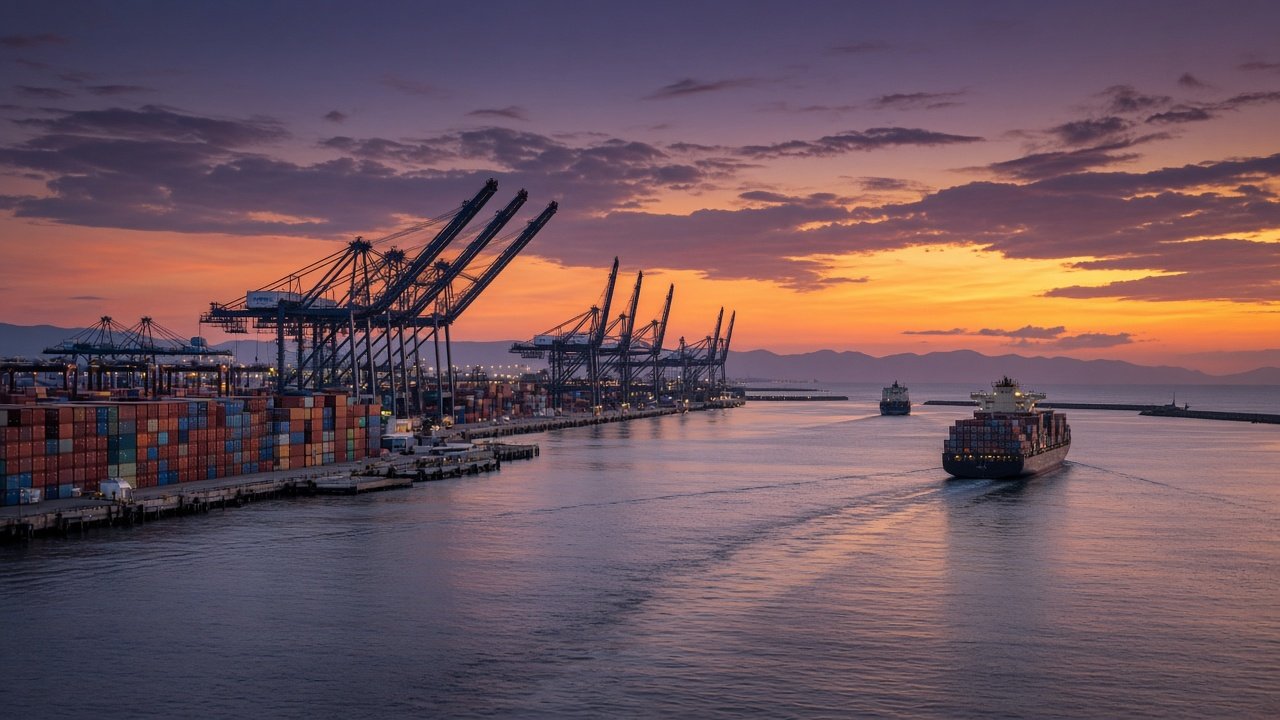
China sold the world $1.04 trillion more than it bought in the first ten months of 2026, passing the trillion-dollar mark for the second year running. What a trade surplus really measures, why the IMF traces this one to Chinese savings and weak investment rather than to clever factories alone, Beijing's case that a surplus is not overcapacity, why steelmakers from Brazil to South Africa are raising duties while African buyers import record amounts of cheap Chinese solar panels, and what tariffs can and cannot do about it. Explainer with a short opinion section.
On 10 November China’s customs office published its October trade figures, and one number travelled around the world within hours. In the first ten months of 2026 China sold abroad $1.04 trillion more goods than it bought, according to Reuters. It is the second year in a row above a trillion, and it got there a month faster than in 2025, when the full-year surplus set a record of about $1.2 trillion (CNBC).
For most people a “surplus” sounds like good housekeeping. So why do governments from Brussels to Brasília treat this one as a problem, why does Beijing insist it isn’t, and who is actually right?
What the number says
In October alone, official customs data show exports of $412.3 billion, up 35.2% on a year earlier, and imports of $307.1 billion, up 41.6%. The monthly surplus was about $105 billion (Türkiye’s Ministry of Trade, citing Trading Economics).
Two details matter. First, much of the boom is the global race to build artificial-intelligence data centres: Chinese semiconductor exports rose 111% in the first ten months and high-tech exports 48%, Reuters reports. Second, imports are rising too, and in October faster than exports. Beijing points to exactly that as proof that it is not hoarding.
At home the picture is weaker. Retail sales grew just 1.1% in September, and domestic car sales fell for a 12th straight month while car exports kept growing (CNBC; Reuters). Factories are selling abroad what Chinese households are not buying.
Why a surplus is not just “selling well”
A trade surplus is an accounting mirror. Over a year, a country’s current account (trade plus income flows) equals what it saves minus what it invests at home. If a country saves far more than it invests, the leftover output has to go abroad, and the leftover money is lent to the rest of the world.
That is where the IMF’s 2026 External Sector Report places China. Private saving there hovered around 39% of GDP in 2015–2019, “roughly double” the level in other advanced and emerging economies, which the Fund ties mainly to weak social safety nets: families save for illness, old age and children’s schooling because the state covers little. Since 2023 a second force has pushed the surplus up: investment fell, first in housing after the 2022 property crash and then in factories and infrastructure. China’s current-account surplus grew by about $300 billion in 2025, the largest widening anywhere in at least 25 years, to roughly 0.6% of world GDP.
The IMF adds a third factor. Prices in China barely rose in 2025, so its goods became cheaper relative to trading partners’ even without any official devaluation, a “real exchange rate depreciation” that helped exports (IMF Article IV, February 2026).
Beijing’s case
China’s Commerce Ministry answered the criticism in a position paper on 28 July. Its main points, as reported by Yicai:
- A big surplus is not proof of “overcapacity”. Britain, the United States, Japan and Germany all ran long surpluses when they were the world’s workshop.
- China does not “deliberately pursue” a surplus. Its exports reflect scale, innovation and other countries’ own demand for solar panels, batteries and electric cars.
- Counting services and investment income, where China runs deficits, its current-account surplus is about 3.7% of GDP, “reasonable by international standards”. (The IMF puts the 2025 figure at 3.3%; the two may be measuring different periods.)
The People’s Daily added a pointed comparison: the EU itself ran a $214.6 billion surplus in pharmaceuticals in 2025, and about 80% of US-made chips are exported. Nobody calls those overcapacity.
Part of this is fair. The IMF itself says the euro area has the world’s second-largest surplus, and that the United States, with a deficit of about 0.9% of world GDP, has the biggest imbalance of all (IMF blog, July 2026). A deficit country that spends more than it saves pulls in imports from somewhere. The Fund’s recommendation is action on both sides, not only in Beijing.
Who feels it, and how
The answer depends on where you stand.
Europe. The EU’s goods deficit with China has reached about €360 billion a year, more than $1 billion a day (AP). In August one in eight new cars bought in the bloc was Chinese (POLITICO Europe). Brussels has reached a deal with Beijing to limit hybrid-car exports and keeps adding duties, such as up to 48.1% on a Chinese roofing fabric in late October (European Commission). Beijing answers in kind, for example with an anti-dumping probe into an EU chemical opened on 3 October (MOFCOM).
The Global South. The surprise is that the sharpest pressure now falls on developing countries. When US tariffs closed part of the American market in 2025, about $150 billion of Chinese exports were redirected elsewhere, Global Trade Alert estimates. Southeast Asia absorbed $65–70 billion, Sub-Saharan Africa about $25 billion (more than 20% above its usual level), Latin America about $20 billion and the Gulf states about $19–20 billion. The EU’s and Japan’s shares actually fell.
These countries are reacting. Brazil set five-year duties of roughly $323–670 per tonne on Chinese cold-rolled steel, Indonesia protects its textile mills, Egypt has steel safeguards (Peacock Tariff Consulting), South Africa imposed 74.98% on Chinese structural steel (China-Global South Project) and Mexico finalised duties on Chinese hot-rolled steel in September. The Latin American Steel Association claims Chinese industrial subsidies reach about $980 billion a year, some 5% of GDP (IBTimes MX). That figure comes from an industry lobby and I could not confirm it from an official source, so treat it as a claim, not a fact.
The buyers. The same flood is also a gift. Chinese solar panel exports to Africa rose 53% to 23 gigawatts in the year to June 2026, Ember reports, and Pakistan installed about 27 gigawatts of rooftop and small-scale solar in two years (Ember). For a family in Lahore or Lagos, “overcapacity” means light at night. The steelworker in Minas Gerais and the solar buyer in Kano are looking at the same trade data from opposite sides.
Chinese households. They are the quietest party. A surplus built on high precautionary saving means people who earn the money consume less of it than they could. The IMF estimates that its recommended reforms, from better pensions and health cover to finishing pre-sold homes, could raise consumption by about 4 percentage points of GDP in five years (IMF).
Can tariffs fix it?
Tariffs can protect a particular industry for a while: Brazil’s flat-steel imports fell 22.6% in a single month as its duties approached, though they stayed above the previous year’s level (Peacock Tariff Consulting). But tariffs move the surplus more than they shrink it. US tariffs in 2025 did not reduce China’s total exports, which ended the year about $272 billion above their 2022–2024 average (Global Trade Alert); they pushed them toward Southeast Asia, Africa and Latin America, which then raised their own walls. If every country blocks one product, the saving-investment gap inside China is still there, and the goods look for the next open door.
The fix the IMF keeps naming is domestic: Chinese households need the confidence and income to spend more, and deficit countries such as the United States need to save more. Neither is quick. Beijing’s 15th Five-Year Plan (2026–30) makes consumption a priority, and the Fund says Chinese policymakers are “taking steps in the right direction”. But Chinese leaders have practical reasons to move slowly: exports protect factory jobs while the property slump drags on, and handing cash to households instead of building industry is a deep change in how the state works. Deficit countries have their own constraint: cutting budget deficits or raising saving is politically painful everywhere.
The calendar adds urgency. The US–China tariff truce was extended only to 10 January 2027, and Xi Jinping and Donald Trump are expected to meet at the APEC summit in Shenzhen next week (Reuters).
Opinion: the surplus is a symptom, and its cost is shared unfairly
China is right that selling good products cheaply is not a crime, and that the West’s sermons on imbalances ignore its own role: the American deficit is the other half of the Chinese surplus. But “we don’t pursue a surplus” is not the same as “our policies don’t produce one”. When a state steers savings into factories instead of into pensions and clinics, the result is predictable, and the bill is not paid in Washington. It is paid by a textile mill in Indonesia, a steel town in South Africa and, quietly, by Chinese families who save because they cannot count on care in old age.
At the same time, a blanket wall against Chinese goods would make the poorest buyers pay most, because the cheap solar panel is often the only affordable route to electricity. The better path is narrower: targeted defence where dumping is proven, open doors for the goods that poorer countries need, and steady pressure on both Beijing and Washington to fix the saving habits behind the numbers. A trillion-dollar surplus is not a trophy or a threat. It is a sign that somewhere, people are consuming less than they produce, and somewhere else, more.
Sources
- General Administration of Customs of China: Total export and import values by trade mode, October 2026
- Republic of Türkiye Ministry of Trade: China's trade surplus reached $1.04 trillion in January–October 2026
- Reuters: China's trade surplus soars past $1 trillion as AI boom powers exports (10 November 2026)
- CNBC: China's trade surplus tops $1 trillion, reinforcing calls to rebalance (10 November 2026)
- IMF: 2026 External Sector Report, Chapter 1
- IMF blog: Rising Global Imbalances Underscore Need to Confront Domestic Distortions (30 July 2026)
- IMF: Executive Board concludes 2025 Article IV consultation with China (18 February 2026)
- IMF: How China's Economy Can Pivot to Consumption-led Growth (18 February 2026)
- Yicai Global: China says high exports, big trade surpluses don't equate to overcapacity (29 July 2026)
- People's Daily Online: Uprooting the 'overcapacity theory' (30 July 2026)
- AP: EU faces economic showdown with China over a daily $1 billion trade deficit
- POLITICO Europe: China trade talks test EU's appetite for tougher action
- European Commission: Commission acts against imports of PET Spunbond from China (30 October 2026)
- MOFCOM Announcement 2026 No. 44: anti-dumping investigation into p-nitrotoluene from the EU (3 October 2026)
- Global Trade Alert (Simon Evenett): Trade Redirection of Chinese Exports During 2025 (18 February 2026)
- Peacock Tariff Consulting: Duty Wave 26
- The China-Global South Project: Chinese exports hit trade hurdles from Africa to Asia (24 March 2026)
- IBTimes MX: Mexico's steel industry launches new offensive against Asian imports
- Ember: The take-off in African solar that official statistics can't yet see
- Ember: The solarisation of Pakistan's energy economy
Comments