 Isidora & Cos Explain
Why Does Gas Set the Price of Electricity, Even When Most Power Comes From Sun and Wind?
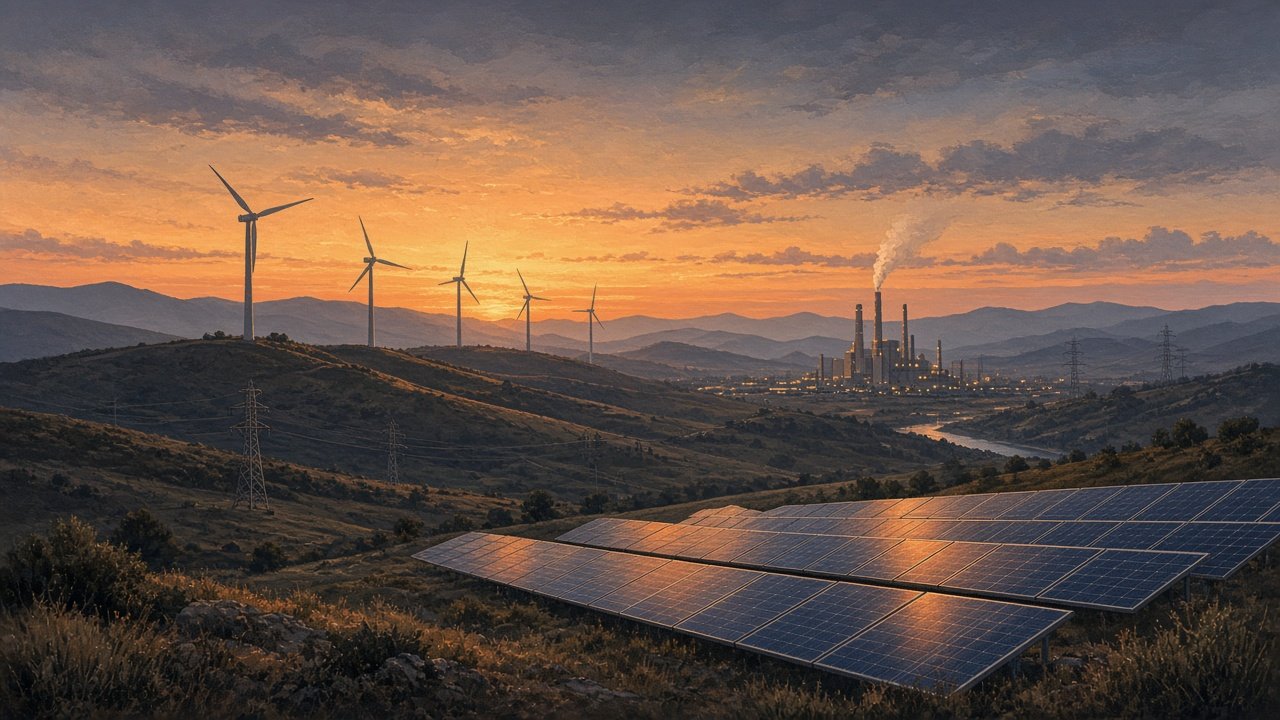
Greek wholesale power hit its 2026 high this week even though renewables still made almost half of the country's electricity. The reason is a pricing rule used across Europe and much of the world: the last, most expensive plant needed sets the price for everyone. How it works, why economists defend it, who wins and loses, what Spain, Greece, India, Australia and China tried instead, and what it means for poorer gas importers. Explainer with a short opinion section.
On Monday 26 October, the average wholesale price of electricity in Greece reached €258.52 per megawatt-hour, its highest level of 2026 and among the six highest in Europe, according to To Vima. The same day, the European gas benchmark touched €97.64/MWh, a level not seen since the 2022 crisis, amid fears of renewed strikes on Iran, reduced Qatari LNG shipments and EU gas storage only about 75% full.
Here is the puzzle. In the week before, renewables still produced 46% of Greece’s electricity and gas 43%. Sun and wind have no fuel bill. So why does the price of the whole system move with the price of gas?
The last plant sets the price for everyone
Most wholesale power markets, in Europe and in many other places, run a daily auction. Generators offer electricity at prices that reflect their running costs; the cheapest offers are accepted first, then the next cheapest, until demand is covered. Then, as the EU’s own market design regulation puts it, “the price received by all market participants is set by the last power plant needed to cover the demand.” This is called marginal or “pay-as-clear” pricing.
Wind and solar bid low because their extra cost per unit is close to zero. But on a windless evening, when the sun has set and people cook and heat their homes, demand is only met by switching on gas plants. A gas plant needs roughly two to three units of gas energy for each unit of electricity, so its offer tracks the gas price closely. Whenever gas is needed, even for the last slice of demand, gas sets the price for that hour.
The Greek data shows the mechanism almost like a laboratory. Powergame reported that on 14 October, with renewables at 66% of generation and gas at about 21%, the daily average was €138.95/MWh. Six days later, with renewables at about 43% and gas near 39%, it was roughly €110 higher. Market insiders told the site that on strong renewable days prices hover around €100, and on weak ones “we’re hitting the 200s.” Forward contracts, the same outlet says, point to about €222/MWh for November, more than double November 2025.
Why economists defend a rule that looks absurd
The obvious fix seems to be: pay each plant what it bid (“pay-as-bid”). The European Commission argues this would not make power cheaper, because cheap producers would stop bidding their costs and instead bid what they expect the clearing price to be. Everyone would guess the last plant’s price, and the result would be similar, only less transparent and harder for small producers who guess badly.
There is real-world evidence. England and Wales moved away from a uniform-price pool in 2001. Prices fell around that time, but an Oxford Institute for Energy Studies analysis found the new trading rules had no statistically significant effect; breaking up the dominant generators, coal imports and overcapacity did the work. A 2008 review for the New York grid operator notes that almost all wholesale markets still use uniform pricing.
The defenders have a second argument: the high price is a signal. It tells consumers to save power at scarce hours, tells storage owners when to discharge, and tells investors where new capacity pays. And “free” renewables are not free: their cost is upfront capital, grids and backup, which have to be paid from somewhere.
Who wins when gas is expensive
The weak point is distribution. When gas sets a price of €250, a solar park, hydro dam or old lignite plant whose costs have not changed earns the same €250. The EU regulation admits that low-cost technologies “have consistently recorded high revenues” during the crisis.
Governments responded in 2022 by clawing that money back rather than changing the auction. The EU set a temporary cap of €180/MWh on the revenues of these “inframarginal” producers. Greece went further: a one-off, retroactive 90% levy on producers’ extra margins from October 2021 to June 2022, worth about €375 million according to Reuters, and from July 2022 a cap on payments for each technology that had raised more than €2.7 billion by December, per Euronews. The money funded bill subsidies. Producers objected that retroactive levies raise the risk premium on future investment, which is a real cost even if it shows up years later.
What others tried instead
Spain and Portugal subsidised the gas burned for power from June 2022, the “Iberian exception.” A 2024 study estimates it cut regulated prices by 20 to 28%, and EsadeEcPol put household savings at about €209 in 2022. The side effects: more gas burned, and cheaper Spanish power flowing to France, so Iberian consumers partly subsidised French ones. A review of the evidence is more sceptical, concluding the gains may have been modest or nil depending on assumptions.
India caps prices on its power exchanges; since April 2023 the regulator, CERC, has limited most bids to ₹10 per kWh. That protects buyers, but in scarce hours it can leave demand unmet rather than priced.
Australia shows the limit of caps. In June 2022, high gas and coal costs collided with an administered cap, generators withdrew capacity, and the market operator suspended the spot market for about a week to keep the lights on.
China long held coal-power tariffs near regulated benchmarks. In 2021, with coal prices soaring and power rationing spreading, the planning agency let market prices swing up to 20% either side of the benchmark, with energy-intensive industry exempt from the limit, while household prices stayed stable, as Reuters reported. Fixed prices had not removed the cost; they had moved it onto loss-making plants that produced less.
The EU’s 2024 reform kept marginal pricing but pushes long-term deals: two-way contracts for difference for new subsidised plants, power purchase agreements, and an obligation that fixed-price retail offers remain available. Two-way contracts pay generators a top-up when prices are low and take money back when prices are high. Britain’s version did exactly that in the last crisis: by late 2021 its portfolio was paying back to electricity suppliers.
The people outside the auction
Europe’s price spikes do not stay in Europe. When it bid for LNG in 2022, the IEA found that Pakistan was “all but priced out” of the spot market, its LNG imports fell 19% in eight months, and some blackouts lasted 12 hours a day. Bangladesh stopped buying spot LNG in July and August and shed nearly 20% of its load at the peak. Any European subsidy that keeps gas demand high in a tight market is partly paid for in Karachi and Dhaka.
Scenarios for this winter
If gas stays near €90–100 and the winter is cold, gas will set the price in most evening hours and bills will follow. If the Gulf calms and LNG cargoes return, the gas price, and with it the electricity price, could ease quickly; that sensitivity runs both ways. A third path is renewed political intervention, such as caps or levies, which can soften bills but carries the trade-offs above.
Opinion: blame the exposure, not the formula
My view is that the auction rule is the messenger, not the culprit. Paying everyone the marginal price is defensible as a way to decide which plant runs; the evidence that pay-as-bid would be cheaper is thin. The problem is that too many households and small businesses are paid out in one-hour spot prices while the cheap producers’ revenues are not tied to their costs. Long-term contracts, two-way CfDs and storage that lets solar cover the evening reduce that exposure without breaking the signal. The fair objection is that these take years, while bills arrive next month; short-term relief is legitimate, as long as it does not quietly subsidise burning more gas that poorer countries also need.
Sources
- To Vima: Greece Faces Higher Electricity Bills as Gas Prices Surge (Oct 2026)
- Powergame: Greek Electricity Prices Hit New Record Amid Tough Winter Ahead (20 Oct 2026)
- Powergame: Electricity Price Forecasts Signal Tough Winter Ahead (Oct 2026)
- EUR-Lex: Regulation (EU) 2024/1747 on electricity market design
- European Commission: Electricity market design
- European Commission: Questions and Answers on the revised electricity market design (May 2024)
- EUR-Lex: Council Regulation (EU) 2022/1854 on an emergency intervention to address high energy prices
- Reuters: Greece to tax power firms on windfall profits from higher gas prices (Nov 2022)
- Euronews: Factbox - Windfall tax mechanisms on energy companies across Europe (Dec 2022)
- Hidalgo-Pérez et al.: The Iberian exception (Energy Policy, 2024)
- EsadeEcPol: The effects of the Spanish gas cap on prices, inflation, and consumption six months later (2023)
- An assessment of the Iberian Exception to control electricity prices (Economics and Policy of Energy and the Environment, 2023)
- Bower: Why Did Electricity Prices Fall in England and Wales? (Oxford Institute for Energy Studies, 2002)
- Tierney, Schatzki and Mukerji: Uniform-Pricing versus Pay-as-Bid in Wholesale Electricity Markets (2008)
- Low Carbon Contracts Company: Reconciliation of Q4 2021 payments sees CfD portfolio paying back to electricity suppliers
- CERC (India): Directions to the Power Exchanges, Suo Motu Petition 04/SM/2023
- AEMO: NEM Market Suspension and Operational Challenges in June 2022
- NDRC (China): China deepens market-oriented reform for on-grid price of coal-fired power generation (Oct 2021)
- Reuters: China liberalises coal-fired power pricing to tackle energy crisis (Oct 2021)
- IEA: Gas Market Report Q4 2022, including Global Gas Security Review 2022
Comments